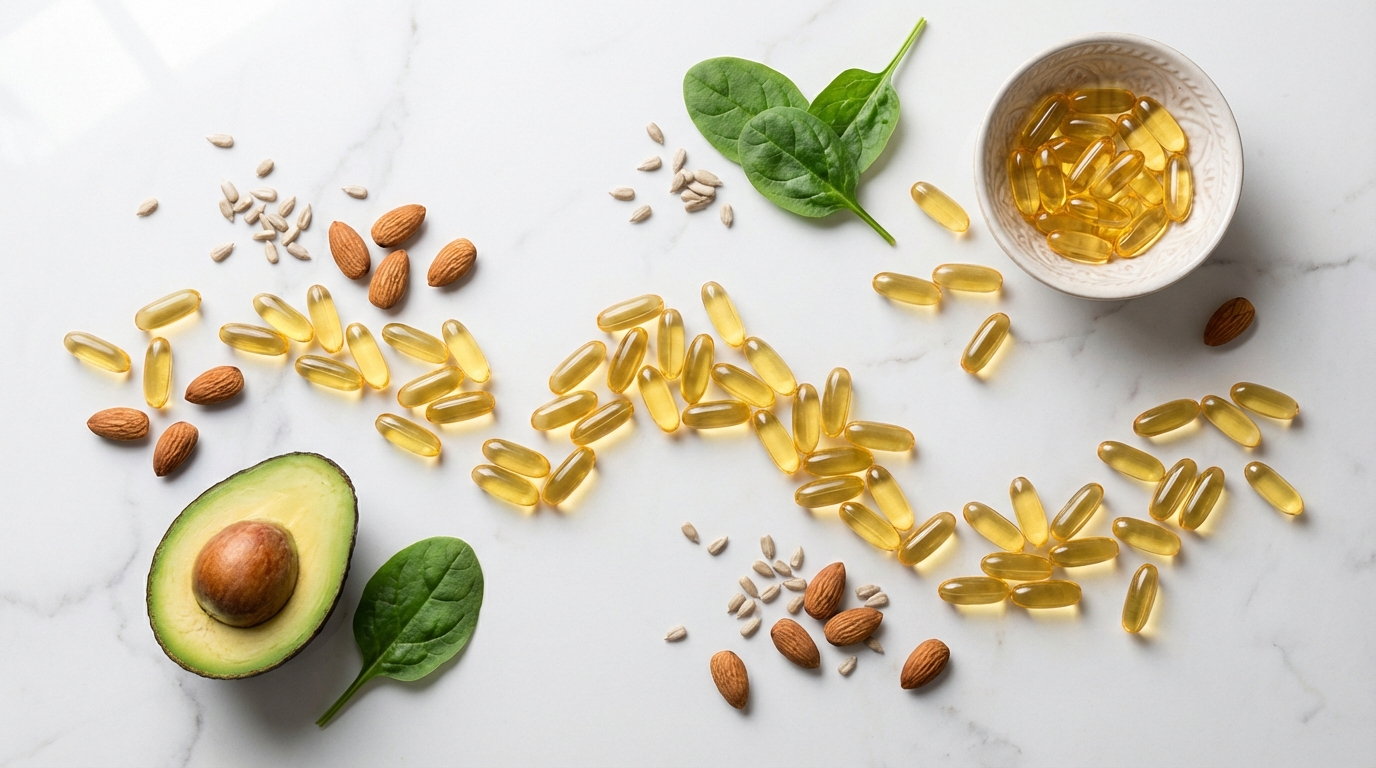
How Much Vitamin E Do You Need Per Day?#
Vitamin E dosage is one of the most commonly searched nutrition topics, and for good reason. This fat-soluble antioxidant plays a critical role in protecting your cells from oxidative damage, supporting immune function, promoting skin health, and maintaining cardiovascular wellness. Yet many people are unsure about the correct vitamin E recommended daily intake, how to read supplement labels, or how to convert vitamin E IU to mg. This comprehensive guide answers all of those questions with data drawn directly from the NIH Office of Dietary Supplements and peer-reviewed research.
Whether you are evaluating a multivitamin label, choosing between natural and synthetic vitamin E supplements, or simply wondering how much vitamin E per day is right for your age and health status, this guide provides the clarity you need.
What Does Vitamin E Do in the Body?#
Vitamin E is not a single compound but a group of eight fat-soluble molecules: four tocopherols and four tocotrienols. Of these, alpha-tocopherol is the form most actively maintained in human plasma and is the standard used to set dietary recommendations.
Antioxidant Protection#
Vitamin E is one of the body's primary lipid-soluble antioxidants. It neutralizes free radicals that would otherwise damage cell membranes, lipoproteins (like LDL cholesterol), and DNA. This function is particularly important in tissues with high oxygen exposure, such as the lungs and red blood cells.
Immune System Support#
Research published in the American Journal of Clinical Nutrition demonstrates that vitamin E enhances T-cell-mediated immune function, particularly in older adults. Adequate intake helps the body mount a stronger defense against infections.
Skin Health#
Vitamin E contributes to skin barrier integrity and photoprotection. It works synergistically with vitamin C to reduce UV-induced damage. Many dermatological products include tocopherol for its moisturizing and anti-inflammatory properties.
Cardiovascular Function#
Vitamin E inhibits platelet aggregation and helps prevent the oxidation of LDL cholesterol, a key step in atherosclerosis. While large-scale trials have yielded mixed results on supplementation for heart disease prevention, maintaining adequate dietary intake remains broadly recommended.
Recommended Daily Intake (RDA) by Age and Sex#
The following table reflects the Recommended Dietary Allowances established by the Food and Nutrition Board at the National Academies of Sciences. Values are expressed in both milligrams (mg) of alpha-tocopherol and International Units (IU) for natural (d-alpha-tocopherol) and synthetic (dl-alpha-tocopherol) forms.
| Age Group | RDA (mg) | RDA (IU, Natural) | RDA (IU, Synthetic) |
|---|---|---|---|
| Infants 0–6 months* | 4 mg | 6.0 IU | 8.9 IU |
| Infants 7–12 months* | 5 mg | 7.5 IU | 11.1 IU |
| Children 1–3 years | 6 mg | 9.0 IU | 13.3 IU |
| Children 4–8 years | 7 mg | 10.4 IU | 15.6 IU |
| Children 9–13 years | 11 mg | 16.4 IU | 24.4 IU |
| Teens 14–18 years | 15 mg | 22.4 IU | 33.3 IU |
| Adults 19+ years | 15 mg | 22.4 IU | 33.3 IU |
| Pregnant women | 15 mg | 22.4 IU | 33.3 IU |
| Breastfeeding women | 19 mg | 28.4 IU | 42.2 IU |
*Adequate Intake (AI) rather than RDA for infants.
For most adults, the vitamin E daily dose recommended is 15 mg per day, which equals approximately 22.4 IU of natural vitamin E or 33.3 IU of synthetic vitamin E.
Converting Vitamin E IU to mg#
One of the most confusing aspects of vitamin E dosage is the IU-to-mg conversion, because the conversion factor differs depending on whether the supplement contains the natural or synthetic form.
Conversion Factors#
- Natural vitamin E (d-alpha-tocopherol): 1 IU = 0.67 mg
- Synthetic vitamin E (dl-alpha-tocopherol): 1 IU = 0.45 mg
Quick Reference Table#
| IU Value | Natural (mg) | Synthetic (mg) |
|---|---|---|
| 100 IU | 67 mg | 45 mg |
| 200 IU | 134 mg | 90 mg |
| 400 IU | 268 mg | 180 mg |
| 800 IU | 536 mg | 360 mg |
| 1,000 IU | 670 mg | 450 mg |
| 1,493 IU | 1,000 mg | — |
| 2,222 IU | — | 1,000 mg |
Why Do Natural and Synthetic Forms Have Different Conversion Factors?#
The difference comes down to stereochemistry. Natural vitamin E (d-alpha-tocopherol) consists of a single stereoisomer — the RRR form — which is the biologically preferred configuration. Your body's alpha-tocopherol transfer protein in the liver selectively binds and redistributes this form.
Synthetic vitamin E (dl-alpha-tocopherol) is a mixture of eight stereoisomers, only one of which (the RRR form) is identical to the natural version. The other seven stereoisomers have reduced biological activity. Because of this, synthetic vitamin E is approximately 50% less bioavailable per milligram than natural vitamin E. The IU system accounts for this difference: a lower weight of natural vitamin E provides the same biological activity as a higher weight of synthetic.
For detailed conversions, visit our dedicated calculators for natural vitamin E IU to mg and synthetic vitamin E IU to mg. To understand IU in general, see our guide on what is an International Unit.
Food Sources of Vitamin E#
Most people can meet the 15 mg RDA through a balanced diet. The following foods are among the richest dietary sources of alpha-tocopherol:
| Food | Serving Size | Vitamin E (mg) | % Daily Value |
|---|---|---|---|
| Wheat germ oil | 1 tablespoon | 20.3 mg | 135% |
| Sunflower seeds (dry roasted) | 1 oz (28 g) | 7.4 mg | 49% |
| Almonds (dry roasted) | 1 oz (28 g) | 6.8 mg | 45% |
| Sunflower oil | 1 tablespoon | 5.6 mg | 37% |
| Safflower oil | 1 tablespoon | 4.6 mg | 31% |
| Hazelnuts (dry roasted) | 1 oz (28 g) | 4.3 mg | 29% |
| Peanut butter | 2 tablespoons | 2.9 mg | 19% |
| Spinach (boiled) | 1/2 cup | 1.9 mg | 13% |
| Broccoli (boiled) | 1/2 cup | 1.2 mg | 8% |
| Kiwifruit | 1 medium | 1.1 mg | 7% |
A handful of almonds and sunflower seeds combined with normal cooking oil usage can easily provide the full daily requirement without supplementation.
Choosing a Vitamin E Supplement: Natural vs Synthetic#
If your diet falls short, supplementation may be appropriate. When selecting a product, consider these factors:
Identifying the Form on Labels#
- Natural: Listed as "d-alpha-tocopherol," "d-alpha-tocopheryl acetate," or "d-alpha-tocopheryl succinate." The single "d-" prefix indicates the natural form.
- Synthetic: Listed as "dl-alpha-tocopherol," "dl-alpha-tocopheryl acetate," or "dl-alpha-tocopheryl succinate." The "dl-" prefix indicates the synthetic racemic mixture.
Which Is Better?#
Natural vitamin E is generally preferred because of its higher bioavailability. Milligram for milligram, you need roughly half the amount of natural vitamin E to achieve the same biological effect as the synthetic version. However, synthetic supplements are typically less expensive. For a deep dive into this comparison, see our guide on natural vs synthetic vitamin E.
Dosage Considerations#
Most over-the-counter vitamin E supplements come in doses of 200 IU or 400 IU, which far exceed the 15 mg (22.4 IU natural) RDA. While these doses are below the tolerable upper limit, there is limited evidence that healthy individuals benefit from high-dose supplementation. The Linus Pauling Institute recommends a daily supplement providing 15 to 30 mg (approximately 22 to 45 IU natural) for adults who do not consume a vitamin-E-rich diet.
Safety: Tolerable Upper Intake Level and Overdose Risks#
The tolerable upper intake level (UL) for vitamin E is 1,000 mg per day of alpha-tocopherol from supplements, set by the Food and Nutrition Board. In IU terms:
- Natural form: 1,000 mg = approximately 1,493 IU
- Synthetic form: 1,000 mg = approximately 2,222 IU
Risks of Exceeding the UL#
The primary concern with excessive vitamin E intake is increased bleeding risk. Alpha-tocopherol inhibits platelet aggregation and interferes with vitamin-K-dependent clotting factors. At very high doses, this anticoagulant effect can lead to:
- Prolonged bleeding time
- Easy bruising
- Hemorrhagic stroke (a rare but serious risk identified in the Physicians' Health Study II)
- Gastrointestinal disturbances (nausea, diarrhea, stomach cramps)
A 2005 meta-analysis published in the Annals of Internal Medicine by Miller et al. raised concerns that high-dose vitamin E supplementation (400 IU/day or more) might be associated with a small increase in all-cause mortality, although subsequent analyses have debated the methodology and conclusions.
Interactions With Other Nutrients and Medications#
Vitamin C Synergy#
Vitamin E and vitamin C work together in a regenerative antioxidant cycle. Vitamin C can regenerate oxidized vitamin E back to its active form. Taking both nutrients together may enhance their collective protective effects against oxidative stress.
Blood-Thinning Medications#
This is the most clinically significant interaction. Vitamin E can potentiate the effects of anticoagulant and antiplatelet drugs, including:
- Warfarin (Coumadin) — vitamin E may increase INR and bleeding risk
- Aspirin — combined antiplatelet effects
- Clopidogrel (Plavix) — additive bleeding risk
If you take any blood-thinning medication, consult your healthcare provider before starting vitamin E supplementation, particularly at doses above the RDA.
Statins and Niacin#
Some research suggests that high-dose vitamin E may reduce the cardiovascular benefits of statin-niacin combination therapy by blunting the increase in HDL cholesterol. Patients on these medications should discuss vitamin E supplementation with their physician.
Fat Absorption#
Because vitamin E is fat-soluble, it is best absorbed when taken with a meal containing dietary fat. Conditions that impair fat absorption (such as celiac disease, Crohn's disease, or cystic fibrosis) may require higher doses or specialized supplementation under medical supervision.
Try the Calculator#
Use our interactive converter to calculate any vitamin E dosage between IU and mg:
Key Takeaways#
- The recommended vitamin E daily dose for adults is 15 mg/day (22.4 IU natural or 33.3 IU synthetic).
- To convert vitamin E IU to mg, multiply by 0.67 for natural (d-alpha-tocopherol) or 0.45 for synthetic (dl-alpha-tocopherol).
- Natural vitamin E is approximately 50% more bioavailable than synthetic due to stereochemical differences.
- Most adults can meet their needs through nuts, seeds, and vegetable oils without supplementation.
- The tolerable upper limit is 1,000 mg/day (1,493 IU natural or 2,222 IU synthetic). Exceeding this increases bleeding risk.
- Vitamin E interacts with blood-thinning medications — always consult a healthcare provider before combining.
- For quick conversions, use our natural vitamin E converter or synthetic vitamin E converter.
Sources#
- NIH Office of Dietary Supplements — Vitamin E Fact Sheet for Health Professionals
- Food and Nutrition Board, Institute of Medicine — Dietary Reference Intakes for Vitamin C, Vitamin E, Selenium, and Carotenoids (2000)
- Miller ER, et al. Meta-analysis: high-dosage vitamin E supplementation may increase all-cause mortality. Ann Intern Med. 2005;142(1):37-46.
- Meydani SN, et al. Vitamin E and respiratory tract infections in elderly. JAMA. 2004;292(7):828-836.
- Linus Pauling Institute — Vitamin E