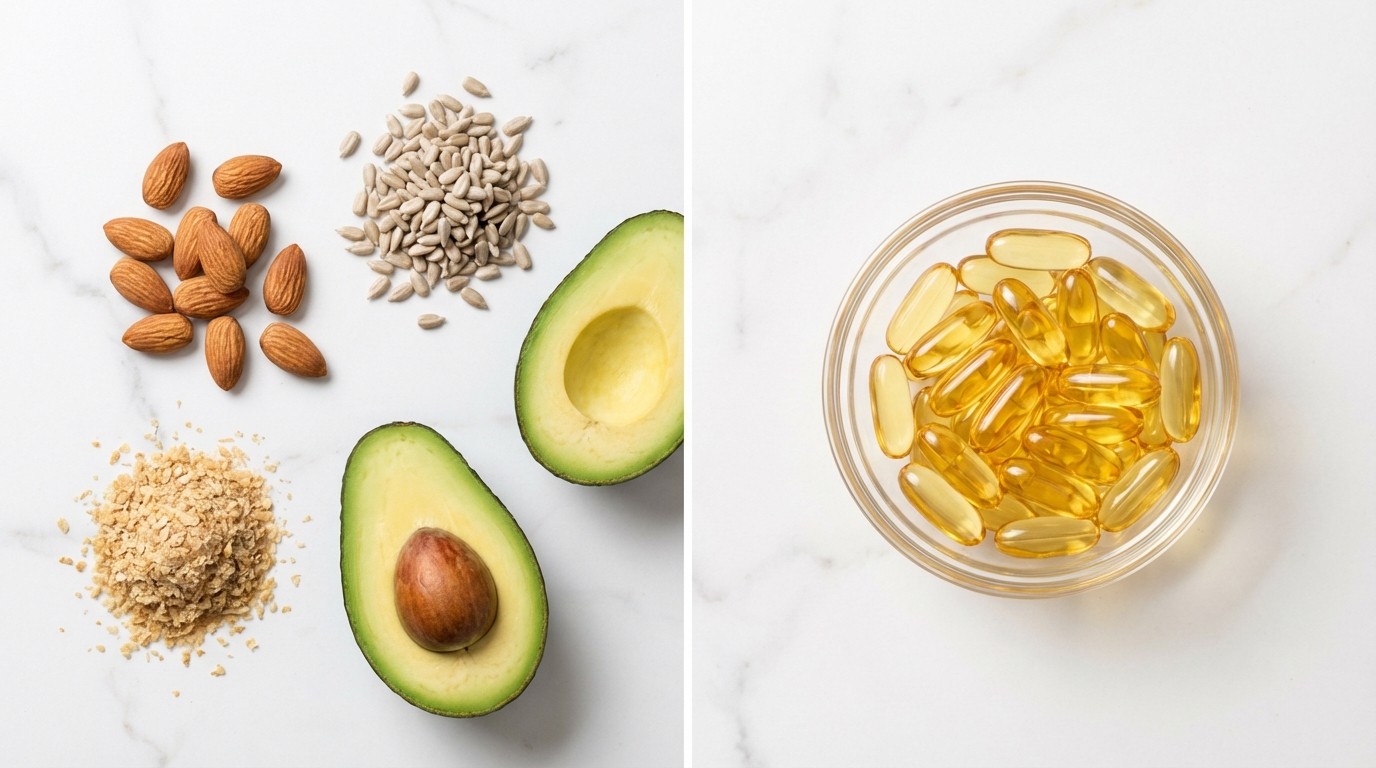
Natural Vitamin E vs Synthetic: What You Need to Know#
Choosing between natural vitamin E and synthetic vitamin E is one of the most important decisions when selecting a supplement. The difference between d-alpha-tocopherol and dl-alpha-tocopherol goes far beyond labeling — it affects how much your body actually absorbs, how much you need to take, and how you convert between IU and mg. This guide breaks down the science behind natural vs synthetic vitamin E so you can make an informed decision.
Understanding this distinction matters because not all vitamin E supplements are created equal. The two forms differ in their chemical structure, how efficiently your body uses them, and even how the dosage appears on the label. According to the NIH Office of Dietary Supplements, the bioavailability gap between the two forms is significant enough to warrant different IU conversion factors — a detail that directly impacts your daily intake calculations.
The Core Difference: d-Alpha-Tocopherol vs dl-Alpha-Tocopherol#
At the most fundamental level, the difference between natural and synthetic vitamin E is a matter of molecular geometry.
Natural Vitamin E (d-Alpha-Tocopherol)#
Natural vitamin E is extracted from plant-based sources such as soybean oil, sunflower oil, wheat germ oil, and other vegetable oils. The "d-" prefix in d-alpha-tocopherol stands for dextrorotatory, meaning the molecule rotates plane-polarized light to the right. More importantly, it refers to a specific three-dimensional arrangement called the RRR-stereoisomer.
This single stereoisomeric form is the exact configuration that your body produces and preferentially recognizes. The alpha-tocopherol transfer protein (alpha-TTP) in the liver has the highest binding affinity for RRR-alpha-tocopherol, which means it is selectively incorporated into very-low-density lipoproteins (VLDL) and distributed throughout the body.
Synthetic Vitamin E (dl-Alpha-Tocopherol)#
Synthetic vitamin E is manufactured through a chemical process that joins trimethylhydroquinone with isophytol. The "dl-" prefix indicates a racemic mixture, meaning it contains equal amounts of both dextrorotatory (d-) and levorotatory (l-) forms. Specifically, synthetic vitamin E is a blend of eight stereoisomers: RRR, RRS, RSR, RSS, SRR, SRS, SSR, and SSS.
Of these eight isomers, only one — the RRR form — is chemically identical to natural vitamin E. The remaining seven have different spatial configurations and are recognized less efficiently by the alpha-TTP protein. As a result, they are metabolized and excreted more rapidly.
Chemical Structure: Why Stereochemistry Matters#
Alpha-tocopherol has three chiral centers in its phytyl tail, each of which can exist in one of two configurations (R or S). This creates the possibility of 2^3 = 8 distinct stereoisomers.
- Natural vitamin E consists exclusively of the RRR configuration at all three chiral centers.
- Synthetic vitamin E is an equimolar mixture of all eight possible stereoisomers (RRR, RRS, RSR, RSS, SRR, SRS, SSR, SSS).
The human body distinguishes between these configurations through the alpha-TTP in the liver. Studies using deuterium-labeled tocopherols have shown that the liver preferentially retains the 2R forms (RRR, RRS, RSR, RSS) and rapidly excretes the 2S forms (SRR, SRS, SSR, SSS). Even among the 2R forms, the RRR isomer has the highest biological activity.
This selective retention is why a given weight of natural vitamin E delivers more biological benefit than the same weight of synthetic vitamin E. The body essentially discards much of the synthetic form before it can exert its antioxidant effects.
Bioavailability: Natural Is Roughly 50% More Effective#
Multiple human studies confirm that natural vitamin E has substantially greater bioavailability than synthetic vitamin E. The most commonly cited figure is that natural vitamin E is approximately 1.36 to 2 times more bioavailable than synthetic, depending on the measurement method and study design.
A landmark study by Burton et al. (1998), published in the American Journal of Clinical Nutrition, used deuterium-labeled d- and dl-alpha-tocopherols administered simultaneously to the same subjects. The researchers found that the body retained approximately twice as much natural vitamin E as synthetic vitamin E over the course of the study.
The practical implication is straightforward: to achieve the same biological effect, you need roughly 50% more synthetic vitamin E by weight than natural. This is precisely why the IU conversion factors differ between the two forms.
IU Conversion Factor Differences#
The International Unit (IU) system was designed to standardize biological potency across different chemical forms. For vitamin E:
- Natural (d-alpha-tocopherol): 1 IU = 0.67 mg
- Synthetic (dl-alpha-tocopherol): 1 IU = 0.45 mg
This means that 1 IU of natural vitamin E and 1 IU of synthetic vitamin E deliver the same biological activity, but they correspond to different weights. The conversion factors account for the bioavailability difference.
Why the Factors Differ#
The IU system assigns values based on biological assays (originally a rat fetal resorption assay). In these assays, it takes only 0.67 mg of natural vitamin E to produce the same effect that requires 0.45 mg of synthetic vitamin E — even though the natural dose weighs more. Wait — that might seem counterintuitive. Here is the clarification:
- 0.67 mg of natural vitamin E = 1 IU
- 0.45 mg of synthetic vitamin E = 1 IU
The natural form weighs more per IU because the IU reflects biological potency, not mass. Since natural vitamin E is more potent per milligram, fewer IU are needed per milligram. Conversely, since synthetic vitamin E is less potent per milligram, more IU are packed into each milligram.
To put it practically: a 400 IU supplement provides 268 mg if it is natural vitamin E, but only 180 mg if it is synthetic. Despite the different weights, both deliver the same theoretical biological activity. For detailed conversions, use our natural vitamin E IU to mg converter or synthetic vitamin E IU to mg converter.
Side-by-Side Comparison Table#
| Feature | Natural (d-alpha-tocopherol) | Synthetic (dl-alpha-tocopherol) |
|---|---|---|
| Source | Extracted from vegetable oils (soy, sunflower, wheat germ) | Chemically synthesized from petrochemicals |
| Stereoisomers | 1 (RRR only) | 8 (racemic mixture) |
| IU Conversion | 1 IU = 0.67 mg | 1 IU = 0.45 mg |
| Bioavailability | Higher (reference standard) | ~50% lower than natural |
| 400 IU in mg | 268 mg | 180 mg |
| UL (1,000 mg/day) in IU | 1,493 IU | 2,222 IU |
| Body Retention | Preferentially retained by liver alpha-TTP | Rapidly excreted (especially 2S forms) |
| Typical Cost | Higher (1.5x to 3x more expensive) | Lower |
| Label Identifier | Prefix "d-" (e.g., d-alpha-tocopherol) | Prefix "dl-" (e.g., dl-alpha-tocopherol) |
| Common Forms | d-alpha-tocopheryl acetate, d-alpha-tocopheryl succinate | dl-alpha-tocopheryl acetate, dl-alpha-tocopheryl succinate |
How to Identify Natural vs Synthetic on the Label#
Reading supplement labels carefully is essential. Here is what to look for:
Look for the Prefix#
- "d-alpha-tocopherol" or "d-alpha-tocopheryl" = Natural
- "dl-alpha-tocopherol" or "dl-alpha-tocopheryl" = Synthetic
The critical difference is a single letter: the "l" in "dl-" indicates the presence of levorotatory isomers, meaning the product is synthetic.
Check the Ingredient List, Not Just the Front Label#
Some products market themselves as "natural" but may contain mixed or synthetic forms. Always check the Supplement Facts panel and the ingredient list for the specific chemical name. The USP (United States Pharmacopeia) designation may also help: USP-grade d-alpha-tocopherol is always natural, while dl-alpha-tocopherol is always synthetic.
Look for RRR- Designation#
Some modern labels use the systematic nomenclature "RRR-alpha-tocopherol" for natural vitamin E. This is the most unambiguous label, as it directly specifies the stereoisomeric form.
Which Form Is Better for Supplementation?#
The evidence strongly favors natural vitamin E for most supplementation purposes, for several reasons:
- Higher bioavailability — Your body retains and uses more of the natural form.
- Lower dose needed — Because of greater potency per milligram, you need less to achieve the same effect.
- Selective liver retention — The alpha-TTP protein preferentially binds the RRR isomer.
- Research basis — Most clinical studies showing vitamin E benefits have used the natural form.
However, synthetic vitamin E is not without merit. It is more widely available, significantly less expensive, and still provides meaningful antioxidant activity. For individuals on a tight budget, synthetic vitamin E at an appropriate dose remains a reasonable option.
Price vs Effectiveness: A Value Analysis#
Cost is a legitimate factor when choosing supplements. Here is a practical comparison:
Scenario: Achieving 15 mg alpha-tocopherol activity per day#
- Natural vitamin E: You need approximately 22.4 IU (15 mg). A bottle of 100 softgels at 100 IU typically costs $12–$18.
- Synthetic vitamin E: You need approximately 33.3 IU (15 mg activity equivalent). A bottle of 100 softgels at 100 IU typically costs $6–$10.
At the RDA level, the cost difference is modest and favors choosing natural vitamin E for its superior absorption. The price gap widens at higher doses (e.g., 400 IU), where natural vitamin E capsules can cost two to three times as much as synthetic equivalents.
When Cost Matters Most#
If you are supplementing at or near the RDA (15 mg/day), choose natural. The price premium is small and the bioavailability advantage is clear.
If you are taking higher doses under medical supervision and cost is a significant concern, synthetic vitamin E can still provide adequate antioxidant support — but discuss this trade-off with your healthcare provider.
For a comprehensive overview of dosing at various levels, see our vitamin E dosage guide.
Try the Calculator#
Convert between IU and mg for both natural and synthetic vitamin E using our interactive tool:
Summary: Making the Right Choice#
The distinction between natural vitamin E (d-alpha-tocopherol) and synthetic vitamin E (dl-alpha-tocopherol) is not merely academic — it has real implications for how much of the vitamin your body actually uses.
Choose natural vitamin E if you want maximum bioavailability, need lower doses for the same effect, and are willing to pay a modest premium. Look for "d-alpha-tocopherol" or "RRR-alpha-tocopherol" on the label.
Consider synthetic vitamin E if cost is the primary constraint, but be aware that roughly half the compound will be excreted unused. Look for "dl-alpha-tocopherol" on the label.
Regardless of which form you choose, stay below the tolerable upper intake level of 1,000 mg/day (1,493 IU natural or 2,222 IU synthetic), and consult your healthcare provider before starting any high-dose supplementation regimen.
For quick conversions between IU and mg, use our natural vitamin E converter or synthetic vitamin E converter.
Sources#
- NIH Office of Dietary Supplements — Vitamin E Fact Sheet for Health Professionals
- Burton GW, et al. Human plasma and tissue alpha-tocopherol concentrations in response to supplementation with deuterated natural and synthetic vitamin E. Am J Clin Nutr. 1998;67(4):669-684.
- Traber MG. Vitamin E regulatory mechanisms. Annu Rev Nutr. 2007;27:347-362.
- Food and Nutrition Board, Institute of Medicine — Dietary Reference Intakes for Vitamin C, Vitamin E, Selenium, and Carotenoids (2000)
- Linus Pauling Institute — Vitamin E