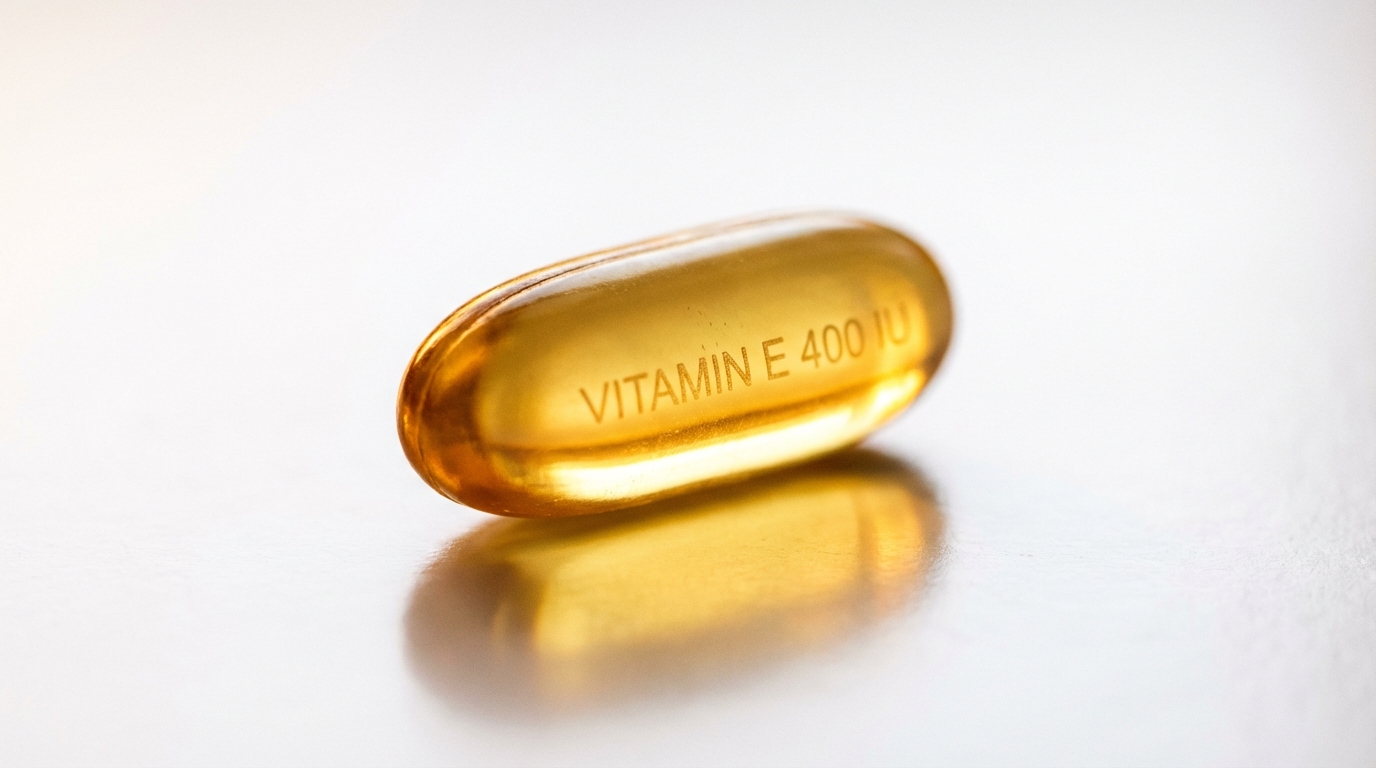
400 IU Vitamin E: How Much Is That in mg?#
If you have a bottle of vitamin E supplements in your cabinet, there is a good chance it says "400 IU" on the label. This is the single most popular over-the-counter vitamin E dosage in the United States and globally. But how much is 400 IU of vitamin E in milligrams, and more importantly, is 400 IU of vitamin E safe to take every day? The answers depend on whether your supplement contains natural or synthetic vitamin E — and on what the clinical research actually shows about high-dose supplementation.
This guide walks through the conversion math, the potential benefits, the safety considerations, and the research controversies surrounding this widely used dosage.
Converting 400 IU Vitamin E to Milligrams#
The mg equivalent of 400 IU depends entirely on whether the supplement contains natural or synthetic vitamin E:
- Natural vitamin E (d-alpha-tocopherol): 400 IU x 0.67 mg/IU = 268 mg
- Synthetic vitamin E (dl-alpha-tocopherol): 400 IU x 0.45 mg/IU = 180 mg
Quick Comparison#
| Measurement | Natural (d-alpha-tocopherol) | Synthetic (dl-alpha-tocopherol) |
|---|---|---|
| IU dose | 400 IU | 400 IU |
| mg equivalent | 268 mg | 180 mg |
| Times above RDA (15 mg) | ~17.9x | ~12x |
| % of UL (1,000 mg) | 26.8% | 18% |
Both forms at 400 IU fall well below the tolerable upper intake level (UL) of 1,000 mg/day, but both are also many times higher than the Recommended Dietary Allowance of just 15 mg/day for adults. This gap between the RDA and the typical supplement dose is a central point in the ongoing debate about vitamin E supplementation.
For precise conversions at any dosage, use our natural vitamin E IU to mg converter or see the 400 IU to mg conversion page.
Why 400 IU Is the Most Common Supplement Dose#
The 400 IU dosage became standard for several reasons: many early clinical trials investigating vitamin E for heart disease and antioxidant benefits used this dose as a benchmark; it fits conveniently into a standard-sized softgel capsule; and decades of marketing have established it as the "default" consumer expectation. The dose is high enough to potentially exceed basic nutritional adequacy while remaining below the UL.
It is worth noting that this convention was established before the most rigorous modern clinical trials were completed. As we will see below, subsequent research has complicated the picture.
Potential Benefits of 400 IU Vitamin E#
Proponents of 400 IU vitamin E supplementation point to several areas of potential benefit:
Antioxidant Protection#
At 268 mg (natural) or 180 mg (synthetic), a 400 IU dose provides substantially more alpha-tocopherol than diet alone. This may enhance the body's capacity to neutralize lipid peroxidation, protect LDL cholesterol from oxidation, and reduce overall oxidative stress.
Skin Health#
Higher plasma alpha-tocopherol levels may support skin barrier function, reduce UV-induced photodamage, and improve wound healing. Some dermatologists recommend 400 IU supplementation for patients with specific skin conditions, although evidence for the general population is limited.
Immune Function#
A study published in JAMA by Meydani et al. (1997) found that elderly subjects taking 200 mg/day of vitamin E showed improved immune response markers, including enhanced delayed-type hypersensitivity and increased antibody titers after vaccination. The 400 IU dose falls in a range where immune benefits have been observed in older adults.
Eye Health#
The Age-Related Eye Disease Study (AREDS) included 400 IU of vitamin E as part of a combination supplement that reduced the risk of advanced age-related macular degeneration (AMD) by approximately 25%. However, vitamin E was tested alongside other antioxidants and zinc, making it impossible to isolate its individual contribution.
Cardiovascular Considerations#
Early observational studies suggested that long-term vitamin E supplementation at 400 IU was associated with reduced cardiovascular risk. However, these findings were not confirmed in subsequent randomized controlled trials.
Is 400 IU of Vitamin E Safe?#
The short answer: 400 IU is below the established upper safety limit, but the nuanced answer requires examining the clinical evidence.
Below the UL#
The tolerable upper intake level for vitamin E is 1,000 mg/day of supplemental alpha-tocopherol:
- 400 IU natural = 268 mg = 26.8% of the UL
- 400 IU synthetic = 180 mg = 18% of the UL
By this standard, 400 IU falls comfortably within the safe range for most healthy adults. The Food and Nutrition Board set the UL based primarily on the risk of hemorrhagic effects (excessive bleeding) at very high doses.
The SELECT Trial Controversy#
The Selenium and Vitamin E Cancer Prevention Trial (SELECT), published in JAMA in 2011, was one of the largest and most rigorous studies of vitamin E supplementation. Over 35,000 men were randomized to receive 400 IU/day of synthetic dl-alpha-tocopheryl acetate or placebo. The key findings:
- Vitamin E supplementation was associated with a 17% statistically significant increase in prostate cancer risk (HR 1.17, 99% CI 1.004-1.36).
- The absolute risk increase was small (76 additional cases per 10,000 person-years).
- The trial was halted early due to the lack of benefit and the emerging prostate cancer signal.
This finding generated significant debate. Some researchers noted that the trial used only synthetic vitamin E, and that the population studied was generally well-nourished men who may not have had low baseline vitamin E status.
The Miller et al. Meta-Analysis#
A 2005 meta-analysis by Miller et al. in the Annals of Internal Medicine pooled 19 clinical trials and reported that high-dose vitamin E (400 IU/day or more) was associated with a small increase in all-cause mortality. However, critics argued the analysis included trials with very sick populations. The Physicians' Health Study II (2008) found no increase in mortality with 400 IU over 8 years.
The Balanced View#
The current scientific consensus, as reflected by the NIH Office of Dietary Supplements and the Linus Pauling Institute, can be summarized as follows:
- 400 IU is below the UL and is unlikely to cause acute toxicity in most adults.
- Routine high-dose supplementation is not recommended for the general population in the absence of a diagnosed deficiency.
- Specific subgroups may benefit, but this should be determined in consultation with a healthcare provider.
- The evidence does not support taking 400 IU vitamin E for primary prevention of cardiovascular disease or cancer in well-nourished individuals.
Who May Benefit From 400 IU Vitamin E#
Certain populations may have a legitimate reason to supplement at the 400 IU level:
- People with documented vitamin E deficiency (rare but can occur with fat malabsorption disorders such as celiac disease, Crohn's disease, cystic fibrosis, or short bowel syndrome)
- Individuals with ataxia with vitamin E deficiency (AVED), a genetic condition requiring high-dose supplementation
- Patients enrolled in AREDS-protocol supplementation for macular degeneration prevention, under ophthalmologist supervision
- Older adults with demonstrably low vitamin E status, where immune function benefits have been documented
Who Should Avoid 400 IU Vitamin E#
Several groups should exercise caution or avoid this dosage entirely:
- People taking anticoagulant medications (warfarin, heparin) — vitamin E has antiplatelet effects that can potentiate bleeding risk
- People taking antiplatelet drugs (aspirin, clopidogrel) — additive bleeding risk
- Individuals scheduled for surgery — vitamin E should typically be discontinued 2-4 weeks before elective surgery to reduce bleeding complications
- Men concerned about prostate cancer risk — based on the SELECT trial findings
- People with vitamin K deficiency — vitamin E can worsen coagulopathy in the setting of low vitamin K
Interactions With Blood-Thinning Medications#
Vitamin E inhibits platelet aggregation through inhibition of protein kinase C, modulation of arachidonic acid metabolism, and competition with vitamin K in the coagulation cascade. At 400 IU, these effects are generally modest in healthy individuals. However, in patients already taking warfarin, the combined effect can increase the International Normalized Ratio (INR) significantly, raising the risk of serious bleeding events. The NIH recommends that patients on anticoagulant therapy discuss any vitamin E supplementation with their physician and monitor their INR more frequently if supplementation is initiated.
Safer Alternative Dosages#
If you are concerned about the 400 IU level, consider these evidence-based alternatives:
- 15 mg/day (22.4 IU natural) — The RDA, achievable through diet. Sufficient to prevent deficiency.
- 30 mg/day (~45 IU natural) — Recommended by the Linus Pauling Institute for adults who do not consume a vitamin-E-rich diet.
- 100-200 IU/day — A moderate range used in some clinical studies with fewer safety concerns.
For many people, optimizing dietary intake through nuts, seeds, and vegetable oils may be preferable. One ounce of almonds provides about 7 mg of alpha-tocopherol — nearly half the daily requirement.
For recommended amounts at every life stage, see our vitamin E dosage guide. For a deeper look at supplement forms, read our guide on natural vs synthetic vitamin E.
Try the Calculator#
Use our interactive converter to calculate any vitamin E dosage between IU and mg:
Key Takeaways#
- 400 IU of natural vitamin E = 268 mg. 400 IU of synthetic vitamin E = 180 mg.
- 400 IU is the most common OTC vitamin E supplement dose, far exceeding the RDA of 15 mg but remaining below the UL of 1,000 mg.
- Potential benefits at this dose include enhanced antioxidant protection, immune support (especially in older adults), and possible contributions to skin and eye health.
- The SELECT trial found a small but significant increased prostate cancer risk in men taking 400 IU of synthetic vitamin E daily.
- The Miller meta-analysis suggested a small increase in all-cause mortality at 400 IU or above, though this finding remains debated.
- 400 IU is not routinely recommended for healthy, well-nourished adults by current guidelines.
- Avoid 400 IU if you take blood-thinning medications, are preparing for surgery, or have specific risk factors.
- Consider lower doses (15-200 IU) or dietary sources as safer alternatives for general health maintenance.
Sources#
- NIH Office of Dietary Supplements — Vitamin E Fact Sheet for Health Professionals
- Klein EA, et al. Vitamin E and the risk of prostate cancer: the Selenium and Vitamin E Cancer Prevention Trial (SELECT). JAMA. 2011;306(14):1549-1556.
- Miller ER, et al. Meta-analysis: high-dosage vitamin E supplementation may increase all-cause mortality. Ann Intern Med. 2005;142(1):37-46.
- AREDS Research Group. A randomized, placebo-controlled, clinical trial of high-dose supplementation with vitamins C and E, beta carotene, and zinc for age-related macular degeneration. Arch Ophthalmol. 2001;119(10):1417-1436.
- Meydani SN, et al. Vitamin E supplementation and in vivo immune response in healthy elderly subjects. JAMA. 1997;277(17):1380-1386.
- Linus Pauling Institute — Vitamin E
- Food and Nutrition Board, Institute of Medicine — Dietary Reference Intakes for Vitamin C, Vitamin E, Selenium, and Carotenoids (2000)