How Much Vitamin A Do You Need Per Day?#
Vitamin A dosage is one of the most commonly misunderstood topics in nutrition. Whether you are reading a supplement label that lists International Units (IU) or a food database measured in micrograms of Retinol Activity Equivalents (mcg RAE), the numbers can be confusing. Getting the right vitamin A daily dose matters because this fat-soluble vitamin plays critical roles in vision, immune defense, skin health, and cellular growth — but taking too much of the preformed type can be toxic.
This guide explains the recommended daily intake of vitamin A for every age group, how to convert between IU and mcg RAE, where to find vitamin A in food, how to choose a supplement, and how to stay within safe limits. All recommendations are based on guidelines from the NIH Office of Dietary Supplements and the World Health Organization.
What Does Vitamin A Do in Your Body?#
Vitamin A is not a single compound but a group of fat-soluble retinoids and carotenoids that serve essential functions throughout the body:
- Vision — Vitamin A is a precursor to rhodopsin, the light-sensitive protein in your retinal cells. Without adequate vitamin A, your ability to see in low light deteriorates, a condition known as night blindness. Severe deficiency can lead to xerophthalmia and permanent blindness, which remains a major public health concern in developing countries according to the WHO.
- Immune function — Vitamin A supports the production and function of white blood cells, helps maintain the mucosal barriers in your eyes, lungs, and gut, and plays a role in both innate and adaptive immunity. Research published in PubMed confirms that vitamin A deficiency significantly increases susceptibility to infections.
- Skin and tissue repair — Retinol stimulates skin cell turnover, supports collagen production, and helps maintain the integrity of epithelial tissues. This is why retinoids are widely used in dermatology for treating acne and signs of aging.
- Cellular growth and differentiation — Vitamin A regulates gene expression involved in cell division and specialization, making it essential during embryonic development, childhood growth, and tissue maintenance throughout life.
Two Forms of Vitamin A: Preformed vs Provitamin A#
Understanding the two main categories of vitamin A is essential for interpreting labels and calculating your daily intake.
Preformed Vitamin A (Retinol and Retinyl Esters)#
Preformed vitamin A, also called retinol, is the active form found exclusively in animal-derived foods — liver, fish oils, dairy products, and eggs. Your body can use retinol directly without any conversion. Because it is immediately bioavailable and fat-soluble, preformed vitamin A can accumulate in the liver, which is why excessive intake carries a risk of toxicity.
Provitamin A Carotenoids (Beta-Carotene, Alpha-Carotene, Beta-Cryptoxanthin)#
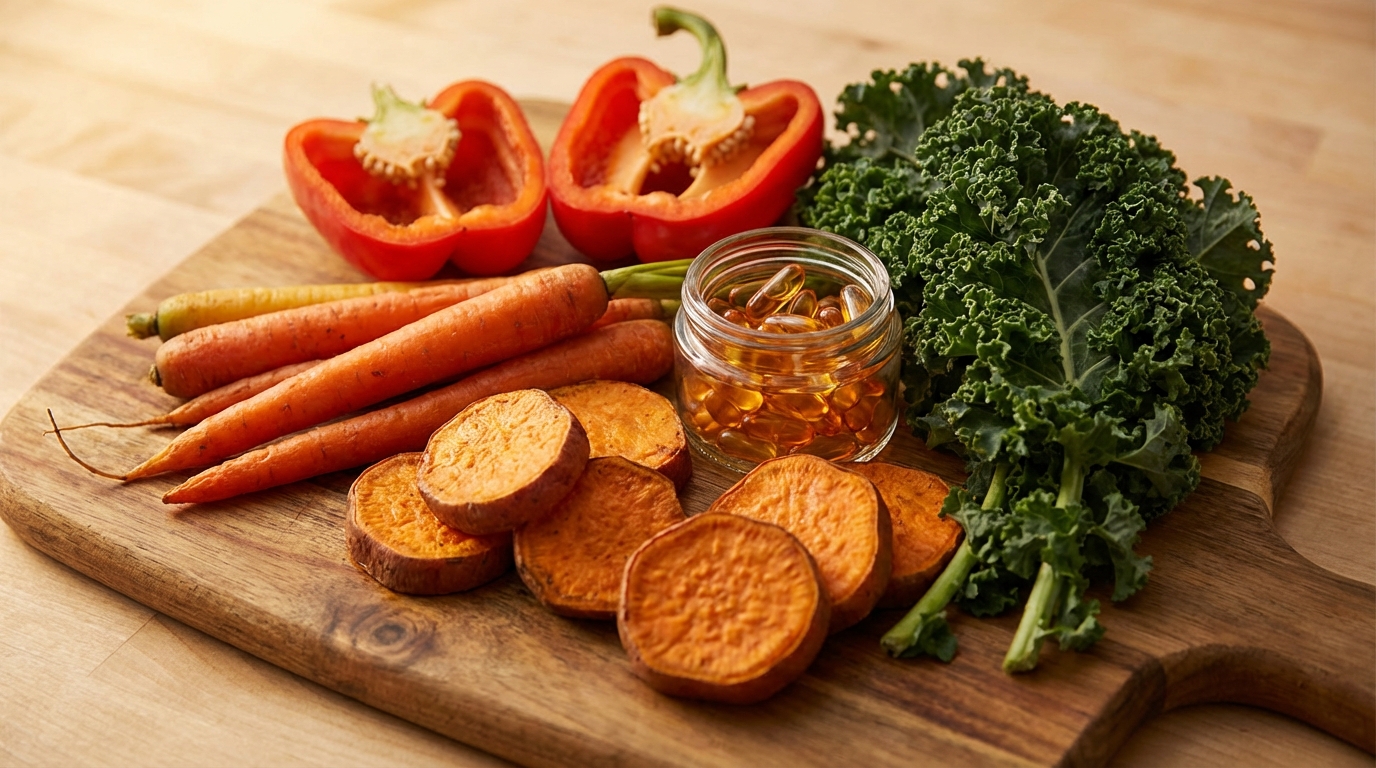
Provitamin A carotenoids are plant-based pigments that your body can convert into retinol. Beta-carotene is the most abundant and efficiently converted of these. It is found in orange and yellow vegetables (carrots, sweet potatoes, pumpkin), dark leafy greens (spinach, kale), and certain fruits (mango, cantaloupe). The conversion is regulated by your body — when you already have enough vitamin A, the conversion rate slows down. This self-regulating mechanism means beta-carotene from food does not cause vitamin A toxicity, even in large amounts.
Vitamin A Recommended Daily Intake (RDA)#
The Recommended Dietary Allowance (RDA) represents the daily intake sufficient to meet the nutritional requirements of 97-98% of healthy individuals. The NIH expresses vitamin A RDA in mcg RAE (Retinol Activity Equivalents), with approximate IU conversions for retinol shown below:
| Life Stage | Age | RDA (mcg RAE/day) | RDA (IU retinol) |
|---|---|---|---|
| Infants | 0–6 months | 400* | 1,333 |
| Infants | 7–12 months | 500* | 1,667 |
| Children | 1–3 years | 300 | 1,000 |
| Children | 4–8 years | 400 | 1,333 |
| Males | 9–13 years | 600 | 2,000 |
| Females | 9–13 years | 600 | 2,000 |
| Males | 14+ years | 900 | 3,000 |
| Females | 14+ years | 700 | 2,333 |
| Pregnant teens | 14–18 years | 750 | 2,500 |
| Pregnant women | 19–50 years | 770 | 2,567 |
| Lactating teens | 14–18 years | 1,200 | 4,000 |
| Lactating women | 19–50 years | 1,300 | 4,333 |
*Adequate Intake (AI) values, as RDA has not been established for infants.
Key numbers to remember: Adult men need 900 mcg RAE per day (equivalent to 3,000 IU of retinol), and adult women need 700 mcg RAE per day (equivalent to 2,333 IU of retinol).
How to Convert Vitamin A IU to mcg RAE#
One of the most confusing aspects of vitamin A dosage is the unit conversion. The conversion factor depends on which form of vitamin A you are dealing with:
For preformed vitamin A (retinol):
1 IU = 0.3 mcg RAE
For provitamin A (beta-carotene from supplements):
1 IU = 0.05 mcg RAE
Conversion Examples#
Example 1: Your multivitamin contains 5,000 IU of vitamin A as retinol. How many mcg RAE?
5,000 IU x 0.3 mcg/IU = 1,500 mcg RAE
Example 2: A beta-carotene supplement lists 10,000 IU. How many mcg RAE?
10,000 IU x 0.05 mcg/IU = 500 mcg RAE
This difference is significant. The same IU number delivers vastly different amounts of actual vitamin A activity depending on the source. Always check whether your supplement contains retinol, beta-carotene, or a mix of both.
For a detailed breakdown, see our dedicated converters for Vitamin A retinol IU to mcg and Vitamin A beta-carotene IU to mcg. For a broader explanation of what IU means, see our guide on International Units.
Quick Reference: Retinol IU to mcg RAE#
| IU (retinol) | mcg RAE |
|---|---|
| 1,000 IU | 300 mcg |
| 2,333 IU | 700 mcg (women's RDA) |
| 3,000 IU | 900 mcg (men's RDA) |
| 5,000 IU | 1,500 mcg |
| 10,000 IU | 3,000 mcg (UL) |
RAE Explained#
RAE stands for Retinol Activity Equivalent. It is the modern standard for measuring vitamin A that accounts for the different bioavailabilities of various vitamin A sources. The RAE system replaced the older Retinol Equivalent (RE) system and provides more accurate comparisons between preformed and provitamin A sources.
Under the RAE system:
- 1 mcg RAE = 1 mcg retinol
- 1 mcg RAE = 12 mcg dietary beta-carotene (from food)
- 1 mcg RAE = 2 mcg supplemental beta-carotene
- 1 mcg RAE = 24 mcg dietary alpha-carotene or beta-cryptoxanthin
Vitamin A Food Sources#
A balanced diet typically provides enough vitamin A for most people. Here are the richest food sources, divided by category.
Animal Sources (Preformed Vitamin A / Retinol)#
| Food | Serving Size | Vitamin A (mcg RAE) | Vitamin A (IU) |
|---|---|---|---|
| Beef liver | 3 oz (85 g) | 6,582 | 21,940 |
| Cod liver oil | 1 teaspoon | 1,350 | 4,500 |
| Butter | 1 tablespoon | 97 | 323 |
| Egg (whole) | 1 large | 75 | 250 |
| Cheddar cheese | 1 oz (28 g) | 75 | 250 |
| Whole milk | 1 cup (240 mL) | 68 | 227 |
Plant Sources (Provitamin A / Beta-Carotene)#
| Food | Serving Size | Vitamin A (mcg RAE) | Vitamin A (IU) |
|---|---|---|---|
| Sweet potato (baked) | 1 medium | 1,096 | 18,443* |
| Carrots (raw) | 1 medium | 509 | 8,568* |
| Spinach (cooked) | 1/2 cup | 472 | 7,943* |
| Kale (cooked) | 1/2 cup | 443 | 7,455* |
| Cantaloupe | 1/2 cup | 135 | 2,272* |
| Mango | 1 medium | 112 | 1,885* |
*IU values for plant sources reflect beta-carotene content (1 IU = 0.05 mcg RAE), which is why the IU numbers appear disproportionately large compared to the mcg RAE values.
Note: The IU values for animal and plant sources are not directly comparable because they use different conversion factors. This is precisely why the nutrition science community prefers mcg RAE — it provides an apples-to-apples comparison regardless of the vitamin A form.
Supplement Selection Guide#
If you cannot meet your vitamin A needs through diet alone, here are key considerations for choosing a supplement:
-
Check the form — Supplements may contain retinol (retinyl palmitate or retinyl acetate), beta-carotene, or a combination. Retinol provides more vitamin A per IU but carries a toxicity risk at high doses. Beta-carotene is safer but less potent per IU.
-
Read the label carefully — Look for vitamin A content expressed in both IU and mcg RAE. If only IU is listed, you need to know the form to calculate the RAE value. A supplement listing "5,000 IU as retinol" provides 1,500 mcg RAE, while "5,000 IU as beta-carotene" provides only 250 mcg RAE.
-
Watch for overlap — If you take a multivitamin plus a standalone vitamin A supplement, add up the total from all sources. Many multivitamins already contain 2,500 to 5,000 IU of vitamin A.
-
Consider mixed formulations — Some supplements provide vitamin A as a blend (e.g., 60% beta-carotene and 40% retinyl palmitate). These offer a balance between immediate bioavailability and safety.
-
Vegans and vegetarians — If you avoid animal products, choose a beta-carotene supplement. Your body will convert what it needs, and excess beta-carotene from supplements is generally safe (though smokers should exercise caution with high-dose beta-carotene supplements).
Tolerable Upper Intake Level (UL) for Vitamin A#
The UL is the maximum daily amount of vitamin A that is unlikely to cause adverse health effects. The upper limit applies only to preformed vitamin A (retinol), not to beta-carotene from food.
| Age Group | UL (mcg RAE/day) | UL (IU retinol/day) |
|---|---|---|
| Infants 0–12 months | 600 | 2,000 |
| Children 1–3 years | 600 | 2,000 |
| Children 4–8 years | 900 | 3,000 |
| Children 9–13 years | 1,700 | 5,667 |
| Teens 14–18 years | 2,800 | 9,333 |
| Adults 19+ years | 3,000 | 10,000 |
For adults, the UL is 3,000 mcg RAE per day, equivalent to 10,000 IU of retinol. Consistently exceeding this amount can lead to hypervitaminosis A, causing symptoms ranging from headaches and nausea to liver damage and bone loss. For a detailed discussion of vitamin A toxicity symptoms and risks, see our Vitamin A Toxicity guide.
Pregnancy and Vitamin A: Critical Safety Information#
Vitamin A is essential during pregnancy for fetal development, including organ formation and immune system maturation. However, excessive preformed vitamin A (retinol) during pregnancy is teratogenic — it can cause serious birth defects affecting the heart, brain, and face of the developing fetus.
The critical points for pregnant women:
- Stick to the RDA — 770 mcg RAE (approximately 2,567 IU retinol) per day for pregnant women aged 19-50.
- Do not exceed the UL — 3,000 mcg RAE (10,000 IU retinol) per day. Some experts advise an even more conservative limit of 5,000 IU during pregnancy.
- Avoid retinol-based supplements unless prescribed — Prenatal vitamins that contain vitamin A typically use beta-carotene or a combination with minimal retinol.
- Avoid liver and liver products — A single serving of beef liver contains over 6,000 mcg RAE, which exceeds the UL in one meal.
- Check skincare products — Prescription retinoids (tretinoin, isotretinoin) are contraindicated during pregnancy. Even some over-the-counter retinol creams may deliver meaningful amounts.
The teratogenic risk is specifically associated with preformed vitamin A (retinol), not beta-carotene. Beta-carotene supplementation during pregnancy is considered safe because the body self-regulates its conversion to retinol.
Calculate Your Vitamin A Dosage#
Use our interactive calculator to instantly convert between IU and mcg RAE for vitamin A:
For beta-carotene conversions, use our beta-carotene converter.
Frequently Asked Questions#
What is the difference between IU and mcg RAE for vitamin A?#
IU (International Unit) measures biological activity, while mcg RAE (Retinol Activity Equivalent) measures the actual retinol-equivalent weight. The conversion depends on the form: 1 IU of retinol equals 0.3 mcg RAE, while 1 IU of beta-carotene equals 0.05 mcg RAE. The FDA now requires mcg RAE on labels, but many supplements still list IU as well. Both units describe the same dose, just from different perspectives.
Is 10,000 IU of vitamin A safe?#
It depends on the form. If the 10,000 IU is entirely from retinol, that equals 3,000 mcg RAE — the exact tolerable upper intake level for adults. While a single dose at this level is unlikely to cause harm, consistently taking 10,000 IU of retinol daily puts you right at the safety ceiling with no margin. If the 10,000 IU comes from beta-carotene, it equals only 500 mcg RAE, which is well within safe limits.
Can I get enough vitamin A from food alone?#
Yes. Most people in developed countries can meet their vitamin A needs through a balanced diet that includes colorful vegetables, fruits, eggs, and dairy. A single baked sweet potato provides over 1,000 mcg RAE, exceeding the adult female RDA. Supplementation is typically unnecessary unless you have a diagnosed deficiency, a restrictive diet, or a malabsorption condition.
Why do supplement labels still use IU?#
The IU system has been the standard for decades, and many consumers and healthcare professionals are familiar with it. The U.S. FDA updated Nutrition Facts labels in 2020 to require mcg RAE for vitamin A, but the Supplement Facts panel may still include IU alongside mcg RAE during the transition period. Over time, mcg RAE is expected to become the primary unit.
How much vitamin A is in a typical multivitamin?#
Most multivitamins contain between 2,500 and 5,000 IU of vitamin A, often as a mixture of retinol and beta-carotene. A product listing "5,000 IU (1,500 mcg RAE) — 50% as beta-carotene" means half comes from retinol (750 mcg RAE) and half from beta-carotene (also expressed as 750 mcg RAE). The retinol portion counts toward the UL; the beta-carotene portion does not.