Can You Take Too Much Vitamin A?#
Yes — and unlike most water-soluble vitamins, vitamin A toxicity is a well-documented and potentially serious medical condition. Because vitamin A is fat-soluble, your body stores excess amounts in the liver rather than excreting them through urine. Over time, these stores can reach dangerous levels, leading to a condition called hypervitaminosis A. The vitamin A overdose symptoms range from mild (headaches, nausea) to severe (liver failure, birth defects), depending on the dose and duration of exposure.
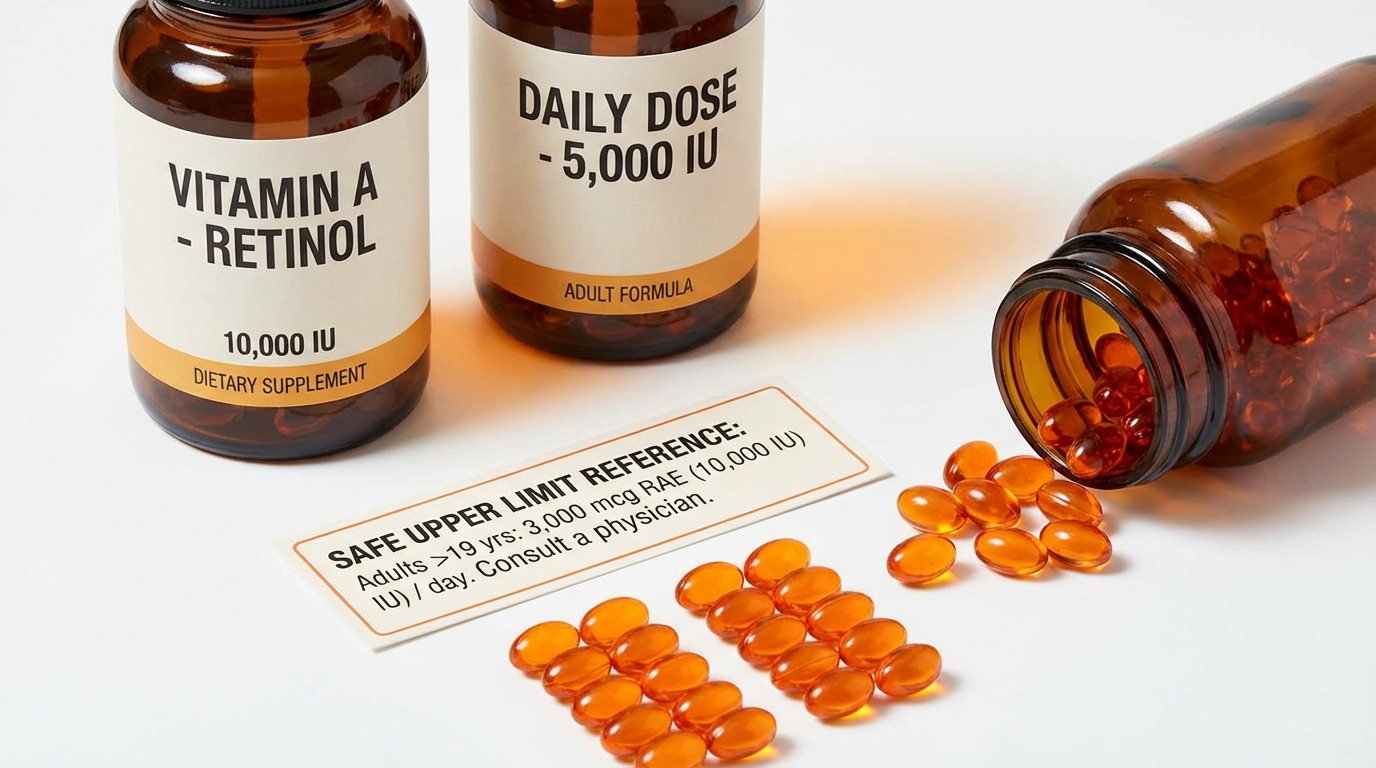
The tolerable upper intake level (UL) for adults is 3,000 mcg RAE per day — equivalent to 10,000 IU of preformed vitamin A (retinol). Consistently exceeding this threshold puts you at risk for toxicity. This guide covers everything you need to know about too much vitamin A: the symptoms, who is at greatest risk, where hidden sources lurk, and what to do if you suspect an overdose.
What Is Hypervitaminosis A?#
Hypervitaminosis A is the medical term for vitamin A toxicity — a condition caused by excessive accumulation of preformed vitamin A (retinol) in the body. The term literally means "too much vitamin A" (hyper = excessive, vitaminosis = a condition caused by vitamins).
It is important to understand that only preformed vitamin A (retinol and retinyl esters) causes toxicity. This form is found in animal products and supplements. Beta-carotene, the plant-based provitamin A, does not cause hypervitaminosis A because your body regulates its conversion and slows down when retinol stores are adequate.
According to the NIH Office of Dietary Supplements, vitamin A toxicity almost always results from excessive supplementation or consumption of liver-based foods rather than from a normal varied diet.
Acute vs Chronic Vitamin A Toxicity#
Vitamin A toxicity manifests in two distinct patterns, depending on the dose and duration of exposure.
Acute Vitamin A Toxicity#
Acute toxicity occurs when a person ingests a very large dose of vitamin A over a short period — typically a single massive dose or several large doses over a few days. In adults, acute toxicity has been reported at single doses exceeding 150,000 mcg RAE (500,000 IU). In children, much smaller amounts can trigger acute reactions.
Symptoms of acute vitamin A toxicity include:
- Severe headache
- Nausea and vomiting
- Dizziness and vertigo
- Blurred or double vision
- Loss of muscular coordination
- Drowsiness and irritability
- Increased intracranial pressure (pseudotumor cerebri)
- Skin peeling (within days of ingestion)
Acute toxicity is dramatic but relatively rare. Historical cases include Arctic explorers who developed severe illness after eating polar bear liver, which contains extremely high concentrations of retinol — up to 9,000 mcg per gram of liver tissue.
Chronic Vitamin A Toxicity#
Chronic toxicity is far more common and develops gradually when a person takes moderately excessive doses over weeks, months, or years. Chronic toxicity typically occurs at sustained daily intakes of 7,500 to 15,000 mcg RAE (25,000 to 50,000 IU) of preformed vitamin A, though some individuals may experience problems at lower levels, particularly if they take amounts above the UL of 10,000 IU daily for extended periods.
Symptoms of chronic vitamin A toxicity include:
- Persistent headaches — caused by increased intracranial pressure
- Dry, rough, or itchy skin — often with cracking and peeling
- Dry, cracked lips (cheilitis) — a hallmark sign
- Hair loss (alopecia) — thinning hair or patchy loss
- Joint and bone pain — aching in the long bones
- Liver damage — hepatomegaly (enlarged liver), fibrosis, and in severe cases, cirrhosis
- Nausea and reduced appetite — chronic digestive discomfort
- Fatigue and weakness — general malaise
- Blurred vision — due to increased intracranial pressure
- Irritability and mood changes — neurological effects
- Elevated blood calcium — hypercalcemia
- Bone density loss — paradoxically, chronic excess vitamin A can weaken bones and increase fracture risk, particularly in postmenopausal women
The insidious nature of chronic toxicity is that symptoms develop slowly and can be mistaken for other conditions. Many people do not connect their symptoms to their supplement regimen until a healthcare provider asks about their intake.
How Much Vitamin A Is Too Much?#
The NIH has established the following Tolerable Upper Intake Levels (UL) for preformed vitamin A:
| Age Group | UL (mcg RAE/day) | UL (IU retinol/day) |
|---|---|---|
| Infants 0–12 months | 600 | 2,000 |
| Children 1–3 years | 600 | 2,000 |
| Children 4–8 years | 900 | 3,000 |
| Children 9–13 years | 1,700 | 5,667 |
| Teens 14–18 years | 2,800 | 9,333 |
| Adults 19+ years | 3,000 | 10,000 |
| Pregnant women (19+) | 3,000 | 10,000 |
| Lactating women (19+) | 3,000 | 10,000 |
For adults, the critical number is 3,000 mcg RAE per day (10,000 IU of retinol). This UL applies to preformed vitamin A only. To convert your supplement's IU value to mcg RAE, use our Vitamin A retinol IU to mcg converter.
It is worth noting that the UL represents the highest daily intake that is unlikely to cause adverse effects in the general population. It is not a recommended target — your actual needs are likely much lower (900 mcg RAE for men, 700 mcg RAE for women). Some research, including a study published in the New England Journal of Medicine, suggests that even chronic intake at 5,000 IU/day (1,500 mcg RAE) of retinol may be associated with reduced bone density in older adults, leading some experts to recommend staying well below the UL.
Why Beta-Carotene Does Not Cause Vitamin A Toxicity#
Beta-carotene, the provitamin A carotenoid found in orange and green vegetables, does not cause hypervitaminosis A. The reason is biological self-regulation: the enzyme that converts beta-carotene to retinol (beta-carotene 15,15'-dioxygenase) is downregulated when your body already has sufficient vitamin A. In other words, your body simply stops making retinol from beta-carotene when it does not need any more.
This is why there is no established UL for beta-carotene from food sources. You can eat as many carrots and sweet potatoes as you like without any risk of vitamin A toxicity. The worst that can happen is carotenodermia — a harmless, reversible yellowing of the skin caused by carotenoid deposits. It is cosmetically noticeable but medically benign and resolves once intake is reduced.
The Exception: Beta-Carotene Supplements and Smokers#
While beta-carotene from food is safe, high-dose beta-carotene supplements present a specific risk for certain populations. Two landmark studies — the ATBC (Alpha-Tocopherol, Beta-Carotene Cancer Prevention) trial and the CARET (Beta-Carotene and Retinol Efficacy Trial) — found that smokers and former asbestos workers who took high-dose beta-carotene supplements (20-30 mg/day) had a statistically significant increased risk of lung cancer compared to those taking a placebo.
The mechanism is not fully understood, but it may involve the pro-oxidant effects of beta-carotene at high concentrations in the lungs of smokers, where oxidative stress is already elevated. The NIH specifically advises that current smokers and people with significant occupational exposure to asbestos should avoid high-dose beta-carotene supplements.
High-Risk Groups for Vitamin A Toxicity#
Certain populations are more vulnerable to the side effects of too much vitamin A:
Pregnant Women#
This is the highest-risk group. Excessive preformed vitamin A is teratogenic — it can cause severe birth defects including malformations of the skull, face, heart, and central nervous system. The critical period is the first trimester, when organ formation occurs. Studies have shown increased birth defect risk at maternal intakes exceeding 10,000 IU/day (3,000 mcg RAE) of retinol, though some authorities recommend pregnant women keep their retinol intake well below this threshold.
Pregnant women should:
- Avoid vitamin A supplements containing retinol unless prescribed by a physician
- Choose prenatal vitamins with beta-carotene as the vitamin A source
- Avoid eating liver or liver-based products (pate, liverwurst)
- Discontinue prescription retinoids (isotretinoin, tretinoin) before and during pregnancy
People with Liver Disease#
Since vitamin A is stored in and metabolized by the liver, individuals with pre-existing liver conditions — hepatitis, fatty liver disease, cirrhosis — are at elevated risk for toxicity even at doses considered safe for healthy adults. Damaged hepatocytes are less able to process and store retinol safely, leading to accelerated liver injury.
People with Chronic Alcohol Use#
Alcohol and vitamin A are both metabolized in the liver, and their interaction is synergistic in causing damage. Research published in the American Journal of Clinical Nutrition shows that even moderate alcohol consumption significantly lowers the threshold at which vitamin A becomes hepatotoxic. People who consume alcohol regularly should exercise particular caution with vitamin A supplementation and discuss their intake with a healthcare provider.
Children#
Children are more susceptible to vitamin A toxicity because of their lower body weight and lower UL thresholds. Accidental ingestion of adult-strength vitamin A supplements is a common cause of acute toxicity in young children. Keep all supplements stored safely out of children's reach.
Common Hidden Sources of Excessive Vitamin A#
Many cases of chronic vitamin A toxicity result from unintentional over-supplementation. Here are the most common culprits:
Multiple Supplements Containing Retinol#
Taking a multivitamin (which often contains 2,500-5,000 IU of vitamin A) alongside a standalone vitamin A supplement, a cod liver oil capsule, and a "skin health" formula can easily push total intake above the UL. Always add up vitamin A from every supplement you take.
Cod Liver Oil#
Cod liver oil is an excellent source of omega-3 fatty acids and vitamin D, but it is also extremely rich in preformed vitamin A. A single tablespoon can contain 4,000-5,000 IU of retinol. Taking cod liver oil in addition to a multivitamin may push you close to or past the 10,000 IU upper limit.
Retinoid Skincare Products#
While topical retinoids (tretinoin, adapalene, retinol serums) are not absorbed in the same quantities as oral supplements, prescription-strength retinoids contribute to overall systemic vitamin A load. This is a particular concern during pregnancy, when even topical retinoids are contraindicated.
Liver and Organ Meats#
A single 3-ounce serving of beef liver contains approximately 6,582 mcg RAE (21,940 IU) of preformed vitamin A — more than twice the adult UL in one meal. Regular consumption of liver is a documented cause of chronic hypervitaminosis A.
Fortified Foods#
Some breakfast cereals, milk products, and meal replacement shakes are fortified with vitamin A. While individual servings contain moderate amounts, consuming multiple fortified products daily alongside supplements can contribute to excessive intake.
Diagnosis and Treatment of Vitamin A Toxicity#
Diagnosis#
If a healthcare provider suspects vitamin A toxicity, they will typically:
- Take a detailed supplement and dietary history — This is often the most revealing step. Many patients are unaware of how much vitamin A they are consuming from multiple sources.
- Order a serum retinol level — Blood levels above 100 mcg/dL (3.49 micromol/L) suggest toxicity, though normal levels do not necessarily rule it out since the liver can store large amounts before blood levels rise.
- Check liver function tests — Elevated ALT, AST, and alkaline phosphatase may indicate liver damage.
- Imaging studies — Liver ultrasound or CT scan to assess hepatomegaly and rule out other causes.
- Bone density scan — If chronic toxicity is suspected, a DEXA scan may be performed to assess bone loss.
Treatment#
The primary treatment for vitamin A toxicity is simple: stop taking vitamin A supplements and reduce dietary retinol intake immediately. In most cases:
- Mild chronic toxicity resolves within days to weeks after discontinuing supplements. Symptoms like headache, skin dryness, and nausea typically improve first.
- Liver damage may take months to improve and, in severe cases with fibrosis or cirrhosis, may not be fully reversible.
- Acute toxicity is treated supportively — IV fluids, antiemetics for nausea, and monitoring for increased intracranial pressure. Most patients recover fully within 1-4 weeks.
- In severe cases, hospitalization may be necessary, particularly if there is significant liver injury, dangerously elevated intracranial pressure, or hypercalcemia requiring calcium management.
There is no specific antidote for vitamin A toxicity. Recovery depends on the duration and severity of the over-supplementation and on the person's baseline liver health.
Calculate Your Vitamin A Intake#
Want to know if your supplement dose is within safe limits? Use our interactive calculator to convert between IU and mcg RAE:
For detailed dosage recommendations by age and life stage, see our Vitamin A Dosage Guide. For a comprehensive overview of upper limits for all vitamins, see our guide on Supplement Safety and Upper Limits.
Key Takeaways#
- Vitamin A toxicity (hypervitaminosis A) is caused by excessive preformed vitamin A (retinol), not by beta-carotene from food. It results almost exclusively from over-supplementation or excessive liver consumption.
- The upper limit for adults is 10,000 IU per day (3,000 mcg RAE) of preformed vitamin A. Consistently exceeding this amount risks liver damage, bone loss, and other serious side effects.
- Acute toxicity results from very large single doses (above 500,000 IU) and causes nausea, headache, and increased intracranial pressure. It is rare but dramatic.
- Chronic toxicity develops gradually from sustained high intake (25,000-50,000 IU/day) and causes dry skin, hair loss, bone pain, and liver damage. It is more common and often goes unrecognized.
- Pregnant women are at the highest risk — excessive retinol is teratogenic and can cause severe birth defects. Pregnant women should avoid retinol supplements and liver products.
- Beta-carotene from food is safe because the body self-regulates its conversion. However, smokers should avoid high-dose beta-carotene supplements due to increased lung cancer risk.
- Always add up vitamin A from all sources — multivitamins, standalone supplements, cod liver oil, fortified foods, and retinoid skincare products all contribute to your total intake.
- If you suspect toxicity, stop supplementation immediately and consult a healthcare provider. Most cases are reversible with prompt intervention.