Retinol vs Beta-Carotene: What Is the Difference?#
If you have ever compared vitamin A supplements, you have likely encountered two distinct forms: retinol and beta-carotene. Both contribute to your vitamin A status, but they differ significantly in their sources, how your body absorbs and uses them, their safety profiles, and how they are measured in International Units (IU). Understanding the retinol vs beta-carotene distinction is essential for choosing the right supplement, interpreting food labels, and avoiding both deficiency and toxicity.
Retinol is preformed vitamin A — it is ready for your body to use immediately. Beta-carotene is provitamin A — a precursor that your body must convert into retinol before it becomes active. This conversion is not one-to-one, which is why the same IU number on a supplement label can mean very different things depending on which form is inside the capsule. In this guide, we break down everything you need to know about these two vitamin A forms so you can make an informed choice.
What Is Retinol (Preformed Vitamin A)?#
Retinol, also known as preformed vitamin A, is the biologically active form of vitamin A that your body can use directly. It belongs to a family of compounds called retinoids, which also includes retinal (important for vision) and retinoic acid (important for gene regulation and cell differentiation).
Sources of Retinol#
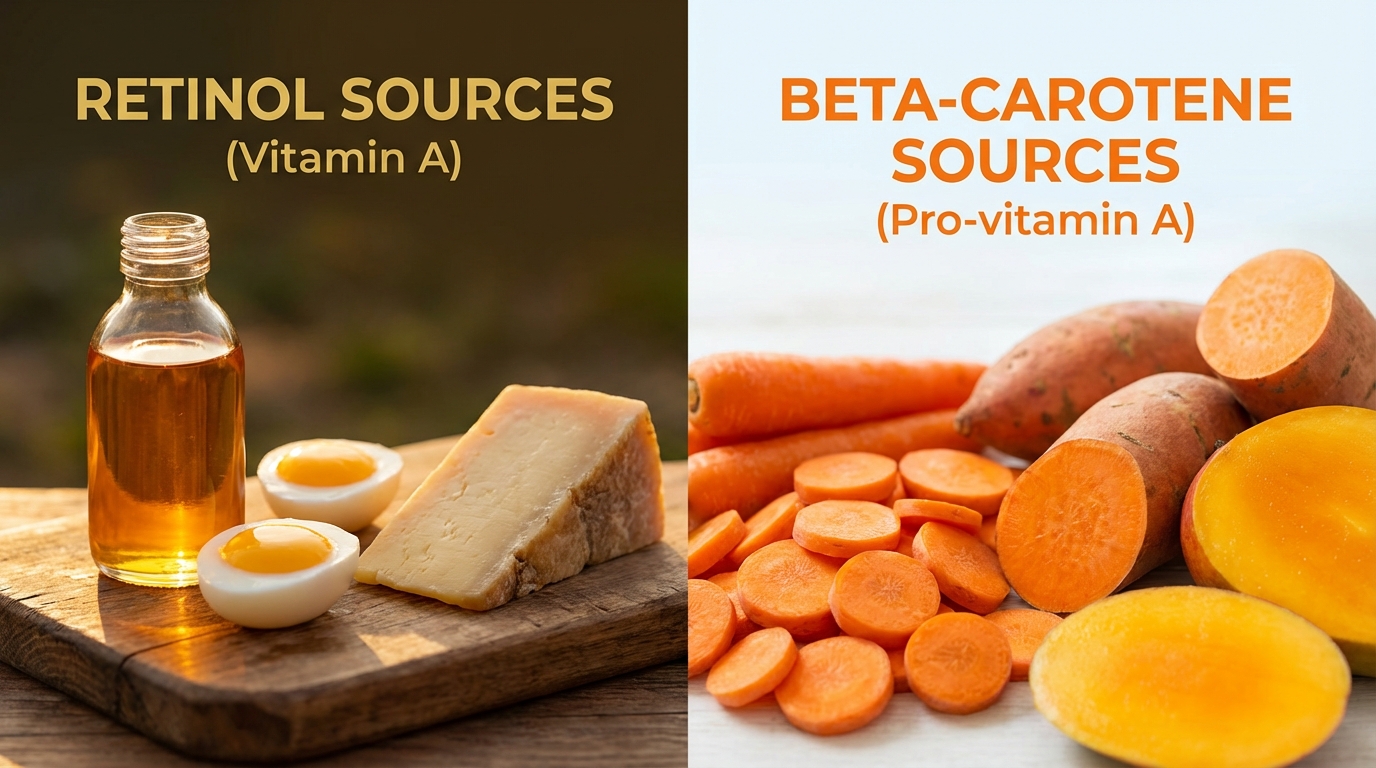
Retinol is found exclusively in animal-derived foods:
- Beef liver — the richest dietary source (6,582 mcg RAE per 3 oz serving)
- Cod liver oil — approximately 1,350 mcg RAE per teaspoon
- Egg yolks — about 75 mcg RAE per large egg
- Dairy products — butter, cheese, whole milk, and cream
- Fatty fish — salmon, tuna, and mackerel contain moderate amounts
- Fortified foods — some cereals and reduced-fat dairy products are fortified with retinyl palmitate
In supplement form, retinol typically appears as retinyl palmitate or retinyl acetate — ester forms that are converted to retinol in the small intestine.
Absorption and Bioavailability#
Retinol has high bioavailability. When you consume retinol from food or supplements, approximately 70-90% is absorbed in the small intestine, provided there is adequate dietary fat present (vitamin A is fat-soluble). Once absorbed, retinol is transported to the liver via chylomicrons and stored in hepatic stellate cells. The liver can store enough vitamin A to supply the body for months, which is precisely why overconsumption leads to accumulation and toxicity.
Because retinol is already in its active form, there is no conversion step required and no efficiency loss. What you ingest is essentially what you get — making it highly effective for correcting a deficiency quickly but also more dangerous if you overshoot the safe limit.
What Is Beta-Carotene (Provitamin A)?#
Beta-carotene is the most abundant and efficiently converted of the provitamin A carotenoids — plant pigments that your body can transform into retinol. It is one of over 600 carotenoids found in nature, but only about 50 have provitamin A activity, with beta-carotene being the most significant.
Sources of Beta-Carotene#
Beta-carotene is abundant in colorful fruits and vegetables:
- Sweet potatoes — the richest common source (1,096 mcg RAE per medium potato)
- Carrots — approximately 509 mcg RAE per medium carrot
- Dark leafy greens — spinach (472 mcg RAE per 1/2 cup cooked), kale (443 mcg RAE per 1/2 cup cooked)
- Winter squash and pumpkin — rich in beta-carotene
- Red and orange bell peppers — moderate amounts
- Cantaloupe, mango, and apricots — fruit sources
- Broccoli and peas — smaller but meaningful amounts
The orange, yellow, and red coloration in these foods is largely due to their carotenoid content. Even dark green vegetables contain high levels of beta-carotene — the green chlorophyll simply masks the orange pigment.
The Conversion Process#
When you eat beta-carotene, the enzyme beta-carotene 15,15'-dioxygenase in the intestinal wall cleaves the beta-carotene molecule to produce retinal, which is then reduced to retinol. However, this process is notably inefficient:
- From food: approximately 12 mcg of dietary beta-carotene yields 1 mcg RAE of retinol. This means only about 1/12th of the beta-carotene you eat from food gets converted to usable vitamin A.
- From supplements: approximately 2 mcg of supplemental beta-carotene yields 1 mcg RAE, because supplements are in a more bioavailable form (not bound in a plant cell matrix).
The conversion rate is further influenced by individual factors including genetics (variations in the BCMO1 gene), thyroid status, zinc and iron levels, and overall vitamin A status. Some research suggests that 15-40% of the population may be "poor converters" with significantly reduced ability to transform beta-carotene into retinol.
Crucially, the conversion is self-regulating. When your body has adequate retinol stores, the conversion enzyme is downregulated, and less beta-carotene is converted. This negative feedback mechanism is why beta-carotene from food does not cause vitamin A toxicity — your body simply stops making retinol from it when it has enough.
Head-to-Head Comparison: Retinol vs Beta-Carotene#
Here is a comprehensive comparison of the two forms of vitamin A across the most important categories:
| Feature | Retinol (Preformed Vitamin A) | Beta-Carotene (Provitamin A) |
|---|---|---|
| Chemical nature | Active retinoid | Carotenoid precursor |
| Sources | Animal foods only | Plant foods only |
| Conversion needed? | No — directly usable | Yes — must be converted to retinol |
| Absorption rate | 70-90% | 3-6% from food (higher from supplements) |
| Bioavailability | High | Low to moderate (depends on food matrix, fat, cooking) |
| IU conversion | 1 IU = 0.3 mcg RAE | 1 IU = 0.05 mcg RAE |
| Toxicity risk | Yes — can accumulate in liver | No — body self-regulates conversion |
| UL established? | Yes — 3,000 mcg RAE/day (10,000 IU) | No formal UL from food |
| Safe during pregnancy? | Caution required — teratogenic at high doses | Generally safe |
| Additional benefits | Direct vision support, gene regulation | Antioxidant properties, reduced oxidative stress |
| Risk for smokers | No specific risk | High-dose supplements linked to lung cancer |
| Best for | Correcting deficiency quickly | Safe daily intake, general antioxidant support |
Conversion Efficiency: How Much Beta-Carotene Equals Retinol?#
The conversion ratios between beta-carotene and retinol are a source of frequent confusion. Here are the key numbers established by the NIH Office of Dietary Supplements:
RAE (Retinol Activity Equivalent) Conversion#
| Source | Amount Needed for 1 mcg RAE |
|---|---|
| Retinol (food or supplement) | 1 mcg |
| Beta-carotene from food | 12 mcg |
| Beta-carotene from supplements | 2 mcg |
| Alpha-carotene from food | 24 mcg |
| Beta-cryptoxanthin from food | 24 mcg |
The 6:1 ratio often cited in older literature (6 mcg beta-carotene = 1 mcg retinol) used the older RE (Retinol Equivalent) system. The current RAE system uses 12:1 for food-based beta-carotene, reflecting updated research showing that absorption from the food matrix is less efficient than previously thought.
IU Conversion Factors#
The IU system assigns different conversion factors to each form, which is critical when reading supplement labels:
- Retinol: 1 IU = 0.3 mcg RAE
- Beta-carotene (supplements): 1 IU = 0.05 mcg RAE
This means that a supplement labeled "10,000 IU vitamin A as retinol" contains 3,000 mcg RAE (the adult UL), while a supplement labeled "10,000 IU vitamin A as beta-carotene" contains only 500 mcg RAE — six times less actual vitamin A activity.
For instant conversions, use our calculators: Retinol IU to mcg RAE or Beta-Carotene IU to mcg RAE.
Which Form Is Right for You?#
The best form of vitamin A depends on your dietary pattern, health status, and specific needs.
Choose Beta-Carotene If You Are:#
-
Vegetarian or vegan — Since retinol comes exclusively from animal products, plant-based eaters rely on beta-carotene for their vitamin A. Eating a variety of orange, yellow, and green vegetables daily typically provides adequate vitamin A for most people. If supplementing, beta-carotene is the appropriate choice.
-
Concerned about toxicity — Beta-carotene's self-regulating conversion makes it virtually impossible to develop vitamin A toxicity from this form. If you prefer a "safety-first" approach, beta-carotene offers peace of mind.
-
Pregnant or planning pregnancy — While adequate vitamin A is essential during pregnancy, the teratogenic risk of high-dose retinol makes beta-carotene a safer supplemental choice. Most well-formulated prenatal vitamins use beta-carotene as their vitamin A source for this reason.
-
Seeking antioxidant benefits — Beyond its role as a vitamin A precursor, beta-carotene is a potent antioxidant in its own right. It neutralizes singlet oxygen and peroxyl radicals, contributing to reduced oxidative stress independent of its vitamin A activity.
Choose Retinol If You Are:#
-
Diagnosed with vitamin A deficiency — When blood levels are low and symptoms are present (night blindness, dry eyes, impaired immunity), retinol corrects the deficiency faster because no conversion is needed. Healthcare providers typically prescribe retinol for therapeutic intervention.
-
A poor beta-carotene converter — Due to genetic variations in the BCMO1 gene, some individuals convert beta-carotene to retinol at significantly reduced rates. If you consume plenty of beta-carotene-rich foods but still show signs of deficiency, you may benefit from preformed retinol. Genetic testing can identify these variants.
-
Managing specific health conditions — Certain conditions that affect fat absorption (Crohn's disease, celiac disease, pancreatic insufficiency) may impair both retinol and beta-carotene absorption, but the impact on beta-carotene is typically more severe because of the additional conversion step required.
A Combined Approach#
Many nutrition experts and supplement manufacturers recommend a mixed formulation that includes both retinol and beta-carotene. A typical approach might be:
- 60% of vitamin A content as beta-carotene (for safety and antioxidant benefits)
- 40% as retinyl palmitate (for guaranteed bioavailability)
This strategy ensures adequate vitamin A delivery while minimizing toxicity risk. For example, a supplement providing 5,000 IU of vitamin A as "50% beta-carotene, 50% retinyl palmitate" would deliver:
- 2,500 IU x 0.3 mcg/IU = 750 mcg RAE from retinol
- 2,500 IU x 0.05 mcg/IU = 125 mcg RAE from beta-carotene
- Total: 875 mcg RAE — well within the RDA and safely below the UL
Safety Comparison#
Retinol Safety Profile#
Retinol has a well-defined toxicity threshold. The UL for adults is 3,000 mcg RAE per day (10,000 IU). Exceeding this consistently can lead to:
- Liver damage (hepatotoxicity)
- Bone density loss and increased fracture risk
- Birth defects if taken during pregnancy
- Skin, hair, and neurological symptoms
Retinol toxicity is almost always caused by supplementation, not food intake (with the exception of liver). For complete information on toxicity symptoms and treatment, see our Vitamin A Toxicity guide.
Beta-Carotene Safety Profile#
Beta-carotene from food has no established UL and is considered safe at any dietary intake level. The body's self-regulating conversion mechanism prevents toxicity. Very high intake may cause carotenodermia (harmless yellow-orange skin discoloration) but no toxic effects.
However, there is one critical exception: high-dose beta-carotene supplements (20-30 mg/day) have been linked to increased lung cancer risk in current smokers and asbestos-exposed individuals. The ATBC and CARET trials demonstrated this increased risk convincingly. The NIH advises that smokers should not take high-dose beta-carotene supplements. This risk does not apply to beta-carotene from food or to nonsmokers.
Calculate Your Vitamin A Conversion#
Use our interactive calculator to convert between IU and mcg RAE for retinol:
For beta-carotene conversions specifically, use our Beta-Carotene IU to mcg converter.
Summary: Making the Right Choice#
Both retinol and beta-carotene are valuable forms of vitamin A, and for most people, the best strategy is to get vitamin A from a variety of dietary sources — both animal and plant-based — rather than relying solely on supplements.
Here is the bottom line:
-
For everyday nutrition, eat a colorful diet rich in beta-carotene (sweet potatoes, carrots, spinach, kale) alongside moderate amounts of retinol-containing foods (eggs, dairy, occasional fish). This approach provides adequate vitamin A with minimal risk.
-
If you supplement, choose a product that clearly labels the form and amount of vitamin A. A mixed formulation (retinol + beta-carotene) offers the best balance of efficacy and safety. Keep total retinol intake below the UL of 10,000 IU (3,000 mcg RAE) per day.
-
If you are vegan or vegetarian, beta-carotene is your primary vitamin A source. Ensure you eat enough orange and green vegetables, cook them (cooking improves beta-carotene bioavailability), and pair them with dietary fat for better absorption. Consider a beta-carotene supplement if your intake is inconsistent.
-
If you are pregnant, prioritize beta-carotene and avoid high-dose retinol supplements. Choose a prenatal vitamin with beta-carotene as the vitamin A source.
-
If you smoke, avoid high-dose beta-carotene supplements. Moderate dietary beta-carotene from food remains safe. If you need supplemental vitamin A, a low-dose retinol supplement (within the RDA) is preferable to a high-dose beta-carotene pill.
-
Always account for all sources — multivitamins, standalone supplements, cod liver oil, fortified foods, and skincare products all contribute to your total vitamin A intake. For detailed dosage recommendations, see our comprehensive Vitamin A Dosage Guide.