
Does Vitamin D Deficiency Cause Fatigue?#
If you are constantly tired despite getting enough sleep, vitamin D deficiency may be the hidden cause. Does vitamin D deficiency cause fatigue? Research says yes. A landmark 2014 study in the North American Journal of Medical Sciences found that 77.2% of patients presenting with fatigue had insufficient vitamin D levels. After supplementation, their fatigue symptoms improved significantly (PubMed: 25340935).
Vitamin D deficiency fatigue is widespread yet frequently undiagnosed because tiredness is so easily attributed to stress, poor sleep, or a busy lifestyle. Understanding the biological mechanism can help you identify whether your low energy has a nutritional root cause.
How Vitamin D Affects Your Energy Levels#
Vitamin D is not just a bone vitamin — it influences energy production at the cellular level in several important ways:
Mitochondrial Function#
Your mitochondria are the energy factories of every cell. Vitamin D receptors are present on mitochondrial membranes, and the active form of vitamin D — calcitriol — directly supports mitochondrial respiration. A 2013 study published in The Journal of Clinical Endocrinology & Metabolism demonstrated that vitamin D supplementation improved mitochondrial oxidative phosphorylation in skeletal muscle, leading to reduced fatigue in deficient participants (PubMed: 23393184).
Muscle Efficiency#
Vitamin D is crucial for muscle contraction and strength. When levels are low, muscles work less efficiently, requiring more effort for everyday activities. This muscle-level inefficiency creates a persistent sense of physical exhaustion even after mild exertion.
Immune Regulation#
Chronic low-grade inflammation — common in vitamin D deficiency — drains your body's energy reserves. Vitamin D modulates the immune system by reducing pro-inflammatory cytokines. Without enough of it, your immune system stays in a heightened state that depletes energy.
Mood and Sleep#
Vitamin D influences serotonin synthesis in the brain. Low serotonin is linked to depression and disrupted sleep-wake cycles, both of which contribute to daytime fatigue. This is one reason seasonal affective disorder (SAD) peaks in winter when sun exposure drops.
Recognizing Fatigue from Vitamin D Deficiency#
Not all fatigue is the same. Here is how vitamin D-related tiredness differs from ordinary exhaustion:
| Feature | Normal Tiredness | Vitamin D Deficiency Fatigue |
|---|---|---|
| Timing | After exertion or poor sleep | Constant, even after rest |
| Sleep quality | Improves with more sleep | Unrefreshing sleep |
| Muscle symptoms | Soreness after exercise | Weakness and aching without cause |
| Seasonal pattern | No clear pattern | Worse in fall and winter |
| Response to rest | Recovers with rest | Does not fully resolve |
| Associated symptoms | Isolated tiredness | Bone pain, low mood, frequent colds |
If your fatigue matches the right column, a vitamin D test is a worthwhile next step.
Who Is Most at Risk?#
Certain groups are disproportionately affected by vitamin D deficiency and, consequently, deficiency-related fatigue:
- Indoor workers and remote workers — limited sun exposure during peak UV hours (10 AM - 3 PM)
- People living at high latitudes — above 37°N (e.g., most of Europe, Canada, northern US), UVB radiation is insufficient for skin synthesis during winter months
- People with darker skin tones — higher melanin levels reduce the skin's ability to produce vitamin D from sunlight by up to 50%
- Older adults (65+) — aging skin produces approximately 75% less vitamin D than younger skin
- Overweight or obese individuals — vitamin D is fat-soluble and gets sequestered in adipose tissue, reducing bioavailability
- People who cover most of their skin — for religious, cultural, or sun-protection reasons
- Those with malabsorption conditions — celiac disease, Crohn's disease, and other GI conditions impair vitamin D absorption
According to the NIH, an estimated 1 billion people worldwide have inadequate vitamin D levels.
Getting Tested: What Levels Are Optimal?#
The gold standard is a serum 25-hydroxyvitamin D [25(OH)D] blood test. This measures your circulating vitamin D and reflects both dietary intake and sun exposure over the past 2-3 weeks.
Interpreting your results:
| Level (ng/mL) | Status | How You Might Feel |
|---|---|---|
| Below 12 | Severely deficient | Severe fatigue, muscle weakness, pain |
| 12-20 | Deficient | Persistent tiredness, low mood |
| 20-29 | Insufficient | Mild fatigue, suboptimal energy |
| 30-50 | Sufficient (optimal) | Normal energy levels |
| 50-80 | High normal | Generally fine for most people |
| Above 100 | Potentially toxic | Risk of hypercalcemia |
For optimal energy and overall health, most experts recommend maintaining levels between 30-50 ng/mL (75-125 nmol/L). The Endocrine Society suggests that some individuals may benefit from levels of 40-60 ng/mL.
How to Boost Your Vitamin D#
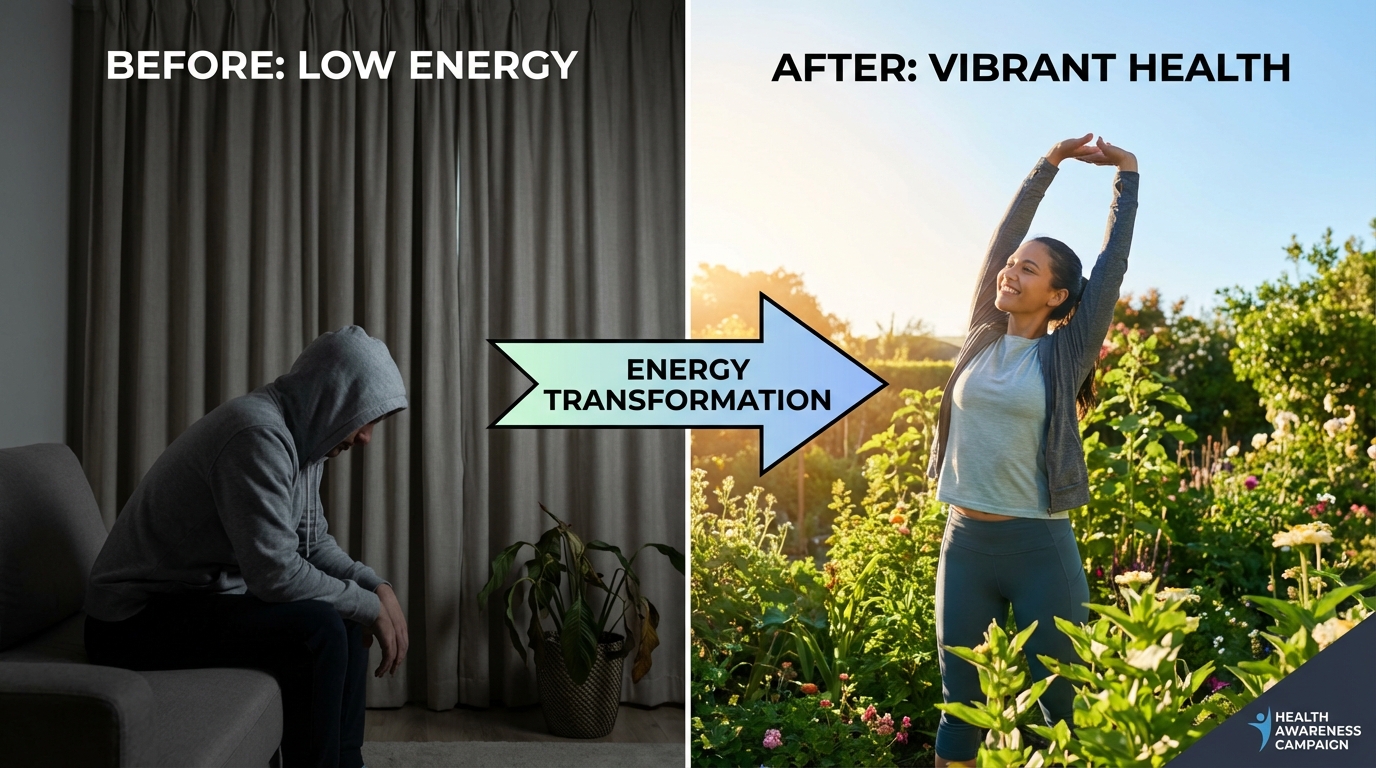
Sunlight#
Your skin produces vitamin D when exposed to UVB rays. Aim for 10-30 minutes of midday sun on your face, arms, and legs, 2-3 times per week without sunscreen. The exact time varies by skin tone — lighter skin needs less, darker skin needs more. Note that sunscreen with SPF 30 reduces vitamin D synthesis by over 95%.
Food Sources#
Few foods naturally contain significant vitamin D, but these are the best options:
| Food | Vitamin D (IU per serving) |
|---|---|
| Wild salmon (3.5 oz) | 600-1,000 |
| Canned tuna (3.5 oz) | 230 |
| Egg yolk (1 large) | 40 |
| Fortified milk (1 cup) | 120 |
| Fortified orange juice (1 cup) | 100 |
| Mushrooms, UV-exposed (3.5 oz) | 400-800 |
Diet alone rarely provides enough vitamin D, which is why supplementation is often necessary.
Supplementation#
For most people, supplements are the most reliable way to achieve and maintain optimal levels. Vitamin D3 (cholecalciferol) is preferred over D2 because it is more potent and better at raising serum levels. Take it with a meal containing fat for maximum absorption.
For a comprehensive breakdown of dosing, see our Vitamin D3 Dosage Guide.
Supplementation Guide#
Here are general dosage recommendations based on your current level and goal:
| Current Level | Recommended Daily Dose | Expected Timeline to Sufficiency |
|---|---|---|
| Below 12 ng/mL | 5,000-10,000 IU* | 8-12 weeks |
| 12-20 ng/mL | 2,000-4,000 IU | 6-8 weeks |
| 20-29 ng/mL | 1,000-2,000 IU | 4-6 weeks |
| Maintenance (30+) | 600-1,000 IU | Ongoing |
*High-dose protocols should be supervised by a healthcare provider. Learn more about safe upper limits in our Vitamin D Toxicity Guide.
Convert your supplement dosage between IU and mcg:
Common supplement conversions: 1,000 IU to mcg | IU to mcg converter
When to expect results: Most people report noticeable improvements in energy within 4-6 weeks of consistent supplementation, provided they reach sufficient serum levels. Full mitochondrial and muscular benefits may take 2-3 months.
When to See a Doctor#
While mild vitamin D deficiency is common and easily treated with over-the-counter supplements, you should consult a healthcare provider if:
- Your fatigue is severe or worsening — sudden onset of extreme tiredness could signal anemia, thyroid disease, or other conditions
- Supplementation does not help after 8-12 weeks — other causes may need investigation
- You have symptoms beyond fatigue — unexplained weight loss, chest pain, shortness of breath, or neurological symptoms warrant prompt evaluation
- You are taking medications that may interact with vitamin D — such as steroids, weight-loss drugs, or cholesterol-lowering medications
- You have kidney or liver disease — these organs convert vitamin D to its active form, and impaired function may require specialized treatment
- You are pregnant or breastfeeding — dosage requirements change and medical guidance is important
A comprehensive workup for unexplained fatigue typically includes vitamin D, thyroid panel (TSH, free T3, free T4), complete blood count, ferritin, and metabolic panel.
Summary#
- Vitamin D deficiency is a proven cause of fatigue. Studies show that the majority of patients with unexplained fatigue have low vitamin D levels, and supplementation improves their symptoms.
- Vitamin D supports energy through mitochondrial function, muscle efficiency, immune regulation, and serotonin production.
- Risk groups include indoor workers, people at high latitudes, those with darker skin, older adults, and individuals with obesity or malabsorption conditions.
- Get your 25(OH)D levels tested — aim for 30-50 ng/mL for optimal energy.
- Supplement with vitamin D3 at 1,000-5,000 IU daily depending on your current level.
- Expect energy improvements within 4-6 weeks of consistent supplementation.
- See a doctor if fatigue persists despite adequate vitamin D levels or if you have other concerning symptoms.
Related Guides#
- Vitamin D Deficiency and Hair Loss: What Science Says — hair thinning is another common symptom of low vitamin D that often accompanies fatigue.
- Vitamin D Dosage for Adults — a detailed breakdown of how much vitamin D you need based on your age, weight, and current levels.
Sources#
- NIH Office of Dietary Supplements — Vitamin D Fact Sheet
- Roy S, et al. "Correction of Low Vitamin D Improves Fatigue." North American Journal of Medical Sciences, 2014. PubMed: 25340935
- Sinha A, et al. "Improving the Vitamin D Status of Vitamin D Deficient Adults Is Associated With Improved Mitochondrial Oxidative Function." JCEM, 2013. PubMed: 23393184
- Holick MF. "Vitamin D Deficiency." New England Journal of Medicine, 2007. PubMed: 17634462