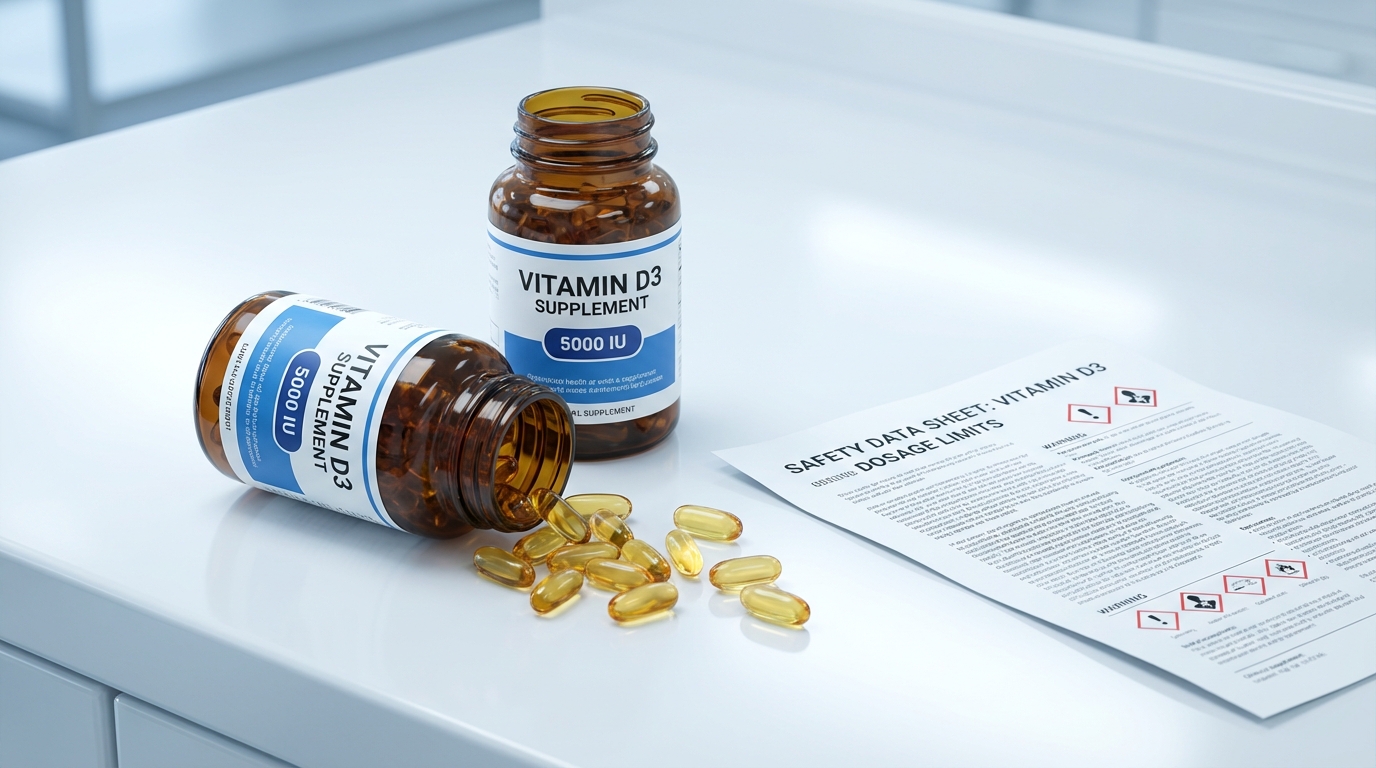
Can You Take Too Much Vitamin D?#
Yes — while vitamin D is essential for health, vitamin D toxicity is a real medical concern. Taking excessive amounts of vitamin D supplements can lead to a dangerous overdose, causing your body to absorb too much calcium and potentially damaging your kidneys and other organs. The upper limit established by health authorities exists precisely to prevent this. Understanding the boundary between a beneficial dose and a harmful one is critical for anyone supplementing with vitamin D.
This guide covers the symptoms of vitamin D toxicity, how much is too much, and how to stay within safe limits.
What Is Vitamin D Toxicity (Hypervitaminosis D)?#
Vitamin D toxicity, medically known as hypervitaminosis D, is a condition caused by excessive accumulation of vitamin D in the body. It does not result from sun exposure or dietary intake alone — it is almost always caused by over-supplementation.
Here is how it works: Vitamin D is a fat-soluble vitamin, which means your body stores it in fatty tissue rather than flushing out any excess through urine (as it does with water-soluble vitamins like vitamin C). When you take large doses over time, vitamin D accumulates. Elevated vitamin D then causes your intestines to absorb too much calcium from food — a condition called hypercalcemia. This excess calcium can deposit in soft tissues, blood vessels, and — most critically — the kidneys, leading to serious health complications including calcification and organ damage.
According to the NIH Office of Dietary Supplements, toxicity is typically observed at blood levels of 25(OH)D above 150 ng/mL (375 nmol/L), usually resulting from sustained daily intake of 10,000 IU or more over extended periods.
Symptoms of Vitamin D Toxicity#
Vitamin D overdose symptoms can range from mild to severe. Because the underlying mechanism involves excess calcium, many symptoms overlap with those of hypercalcemia:
- Nausea and vomiting — among the earliest signs
- Poor appetite and weight loss — reduced desire to eat
- Constipation — disrupted digestive function
- Weakness and fatigue — general malaise
- Frequent urination and excessive thirst — the kidneys working to excrete excess calcium
- Kidney damage — including kidney stones and, in severe cases, kidney failure
- Bone pain — paradoxically, excess vitamin D can weaken bones by pulling calcium from them
- Confusion and disorientation — neurological effects of high calcium
- Heart arrhythmias — in extreme cases, dangerously irregular heartbeat
Symptoms typically develop gradually over weeks or months of excessive intake rather than appearing after a single large dose. If you experience any of these symptoms while supplementing with vitamin D, stop taking the supplement and consult a healthcare provider immediately. Early detection is important — most cases of vitamin D toxicity are fully reversible when caught before significant kidney damage occurs.
How Much Vitamin D Is Too Much?#
The Tolerable Upper Intake Level (UL) is the maximum daily amount unlikely to cause adverse health effects. For vitamin D, the UL set by the NIH is:
| Age Group | Upper Limit (IU/day) | Upper Limit (mcg/day) |
|---|---|---|
| Infants 0–6 months | 1,000 IU | 25 mcg |
| Infants 6–12 months | 1,500 IU | 37.5 mcg |
| Children 1–3 years | 2,500 IU | 62.5 mcg |
| Children 4–8 years | 3,000 IU | 75 mcg |
| Ages 9 and older | 4,000 IU | 100 mcg |
| Pregnant/Lactating | 4,000 IU | 100 mcg |
For adults, the maximum daily dose is 4,000 IU (100 mcg) per day. To convert between IU and mcg, remember that 1 IU of vitamin D3 = 0.025 mcg — or use our IU to mcg converter.
It is worth noting that some researchers argue the UL could safely be set higher, but 4,000 IU/day remains the official guideline endorsed by most health organizations.
Vitamin D 50,000 IU Weekly: Is It Safe?#
You may have seen prescriptions for vitamin D 50,000 IU taken once per week. This is a legitimate medical treatment, typically prescribed for people with a diagnosed vitamin D deficiency. To understand how much that is in mcg, 50,000 IU equals 1,250 mcg.
Short-term use (8–12 weeks): Generally considered safe under medical supervision. The weekly mega-dose is used to rapidly restore depleted vitamin D levels.
Long-term use: More controversial. Extended use of 50,000 IU weekly can lead to vitamin D accumulation and increase the risk of toxicity. Long-term maintenance doses are typically much lower — often 5,000 IU (125 mcg) daily or 50,000 IU monthly.
Side effects of vitamin D 50,000 IU may include nausea, constipation, metallic taste, and elevated calcium levels. These side effects are more common with prolonged use. If your doctor has prescribed this dose, regular blood monitoring of calcium and 25(OH)D levels is essential.
Never self-prescribe 50,000 IU doses. This level of supplementation requires medical oversight and periodic lab work.
Safe Daily Dosage Guidelines#
The Recommended Dietary Allowance (RDA) represents the daily intake sufficient for most healthy individuals:
| Age Group | RDA (IU/day) | RDA (mcg/day) |
|---|---|---|
| Infants 0–12 months | 400 IU | 10 mcg |
| Children 1–13 years | 600 IU | 15 mcg |
| Teens 14–18 years | 600 IU | 15 mcg |
| Adults 19–70 years | 600 IU | 15 mcg |
| Adults 71+ years | 800 IU | 20 mcg |
| Pregnant/Lactating | 600 IU | 15 mcg |
Most over-the-counter vitamin D supplements come in doses of 1,000–5,000 IU. While doses up to 4,000 IU/day are within the established upper limit, many people do well with 600–2,000 IU daily, depending on their baseline levels, sun exposure, and dietary intake.
According to the Mayo Clinic, doses of 1,000–2,000 IU/day are generally safe and effective for most adults who need supplementation.
Risk Factors for Vitamin D Overdose#
Certain individuals are at higher risk for vitamin D toxicity:
- People taking high-dose supplements without monitoring — the most common cause of toxicity
- Individuals with granulomatous diseases — conditions like sarcoidosis and tuberculosis can cause unregulated conversion of vitamin D to its active form
- People with kidney or liver disease — impaired metabolism of vitamin D can lead to accumulation
- Those taking certain medications — thiazide diuretics, for example, can raise calcium levels when combined with vitamin D
- Individuals with low body weight — less tissue to distribute and store vitamin D
- People taking multiple supplements containing vitamin D — accidental double-dosing from multivitamins, calcium + D combos, and standalone vitamin D
Always review all your supplements and medications for vitamin D content to avoid unintentional overdosing. A good practice is to add up the total vitamin D from every source — your multivitamin, any calcium + D supplement, standalone vitamin D capsules, and fortified foods — to get your true daily intake.
How to Check Your Vitamin D Levels#
The definitive way to assess your vitamin D status is a 25-hydroxyvitamin D [25(OH)D] blood test. This test measures the circulating form of vitamin D and is the standard biomarker used by healthcare providers.
Interpreting your results:
| 25(OH)D Level | Status |
|---|---|
| Below 12 ng/mL (30 nmol/L) | Deficient — risk of bone disorders |
| 12–20 ng/mL (30–50 nmol/L) | Inadequate — may not support optimal health |
| 20–50 ng/mL (50–125 nmol/L) | Sufficient — adequate for most people |
| 50–150 ng/mL (125–375 nmol/L) | Potentially harmful — upper range of safety |
| Above 150 ng/mL (375 nmol/L) | Toxic — risk of hypercalcemia |
If you are supplementing with more than 2,000 IU/day, or if you have risk factors for toxicity, consider getting your levels tested every 3–6 months. Your doctor may also order a serum calcium test alongside 25(OH)D to check for hypercalcemia.
Most primary care physicians can order this test as part of routine blood work. Results typically come back within a few days. If your 25(OH)D level is above 50 ng/mL, your doctor will likely recommend reducing or stopping supplementation and retesting in 2–3 months.
Calculate Your Vitamin D Dosage#
Not sure how your supplement dose converts between IU and mcg? Use our interactive calculator to find the exact conversion:
For common conversions, see our Vitamin D3 IU to mcg guide.
Key Takeaways#
- Vitamin D toxicity is rare but real — it almost always results from excessive supplementation, not food or sunlight.
- The upper limit for adults is 4,000 IU (100 mcg) per day — exceeding this consistently raises the risk of harmful side effects.
- Vitamin D 50,000 IU weekly is a prescription-level dose meant for short-term deficiency correction under medical supervision.
- Symptoms of overdose include nausea, vomiting, kidney damage, and dangerously high calcium levels (hypercalcemia).
- Get your blood tested — a 25(OH)D test is the only reliable way to know if your levels are safe.
- More is not always better — for most adults, 600–2,000 IU/day is sufficient. Always consult a healthcare provider before exceeding the UL.