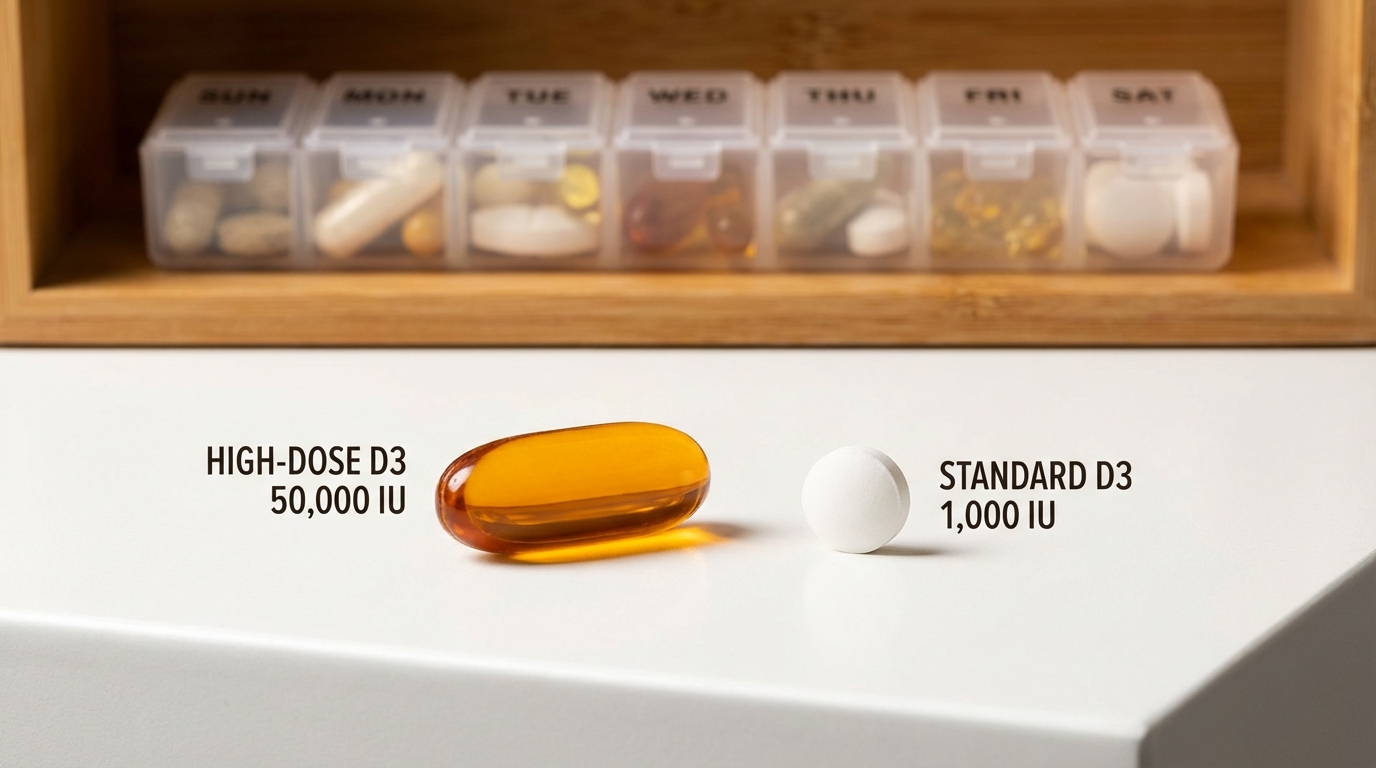
What Is Vitamin D 50,000 IU and Why Is It Prescribed?#
Vitamin D 50,000 IU is a high-dose prescription supplement used to treat moderate to severe vitamin D deficiency. Unlike the over-the-counter supplements you find at pharmacies — typically ranging from 400 to 5,000 IU — a 50,000 IU dose is a therapeutic-level intervention prescribed by a physician to rapidly restore depleted vitamin D levels. At 50,000 IU, each capsule contains 1,250 mcg of vitamin D, which is more than 12 times the tolerable upper intake level (UL) of 4,000 IU (100 mcg) per day set by the NIH Office of Dietary Supplements. This is why 50,000 IU vitamin D is taken once per week rather than daily — spreading the large dose across seven days brings the average daily intake to approximately 7,143 IU, a level many clinicians consider manageable for short-term correction.
The prescription form is most commonly ergocalciferol (vitamin D2), though some physicians prescribe cholecalciferol (vitamin D3) at this dosage. Both forms raise serum 25-hydroxyvitamin D [25(OH)D] levels, but research suggests D3 may be somewhat more effective at sustaining elevated levels over time (Tripkovic et al., 2012). If you have been handed a prescription for 50,000 IU weekly, this guide will walk you through the benefits, side effects, monitoring requirements, and everything else you need to know.
Medical Indications for Vitamin D 50,000 IU Weekly#
Not everyone needs this dose. Physicians prescribe vitamin D 50,000 IU weekly for specific clinical situations where standard supplementation is inadequate:
Diagnosed Severe Deficiency#
The most common reason is a blood test showing 25(OH)D levels below 20 ng/mL (50 nmol/L), classified as deficient by the NIH. Levels below 12 ng/mL (30 nmol/L) represent severe deficiency and almost always warrant aggressive repletion. At these levels, low daily doses simply cannot restore adequate levels quickly enough.
Malabsorption Syndromes#
Patients with conditions that impair fat absorption — such as celiac disease, Crohn's disease, ulcerative colitis, cystic fibrosis, and those who have undergone gastric bypass surgery — often cannot absorb standard doses of vitamin D effectively. The 50,000 IU weekly protocol compensates for poor absorption by providing a large enough bolus that even reduced absorption yields clinically meaningful increases in blood levels.
Obesity#
Vitamin D is fat-soluble and gets sequestered in adipose tissue. Individuals with a BMI over 30 often require 2-3 times more vitamin D than normal-weight individuals to achieve the same serum levels (Ekwaru et al., 2014). The 50,000 IU weekly dose addresses this increased requirement.
Chronic Kidney Disease#
The kidneys play a central role in converting vitamin D to its active form (calcitriol). Patients with chronic kidney disease (CKD) frequently have severely depleted vitamin D and may need high-dose repletion as part of their overall mineral and bone disorder management.
Medication-Induced Deficiency#
Certain medications — including anticonvulsants (phenytoin, phenobarbital), glucocorticoids, rifampin, and some antiretroviral drugs — accelerate the breakdown of vitamin D in the liver. Patients on these medications often require higher replacement doses.
Benefits of Vitamin D 50,000 IU Weekly#
When prescribed appropriately, the 50,000 IU weekly protocol offers several important benefits:
Rapid Correction of Deficiency#
The primary benefit is speed. A standard dose of 1,000-2,000 IU daily may take 3-6 months to normalize severely depleted levels. With 50,000 IU weekly, most patients reach sufficient levels (above 30 ng/mL) within 8-12 weeks. The Endocrine Society recommends this protocol specifically for its efficiency in restoring 25(OH)D to the target range (Holick et al., 2011).
Improved Bone Health#
Severe vitamin D deficiency can lead to osteomalacia (bone softening) in adults and rickets in children. Restoring vitamin D levels reverses these conditions by enabling proper calcium and phosphorus absorption. Patients often report significant reduction in bone pain and muscle weakness within weeks of starting therapy.
Immune System Support#
Vitamin D plays a critical role in innate immunity. Deficiency is associated with increased susceptibility to infections, including respiratory tract infections. A landmark meta-analysis in the BMJ showed that vitamin D supplementation reduced the risk of acute respiratory infections, with the greatest benefit seen in those with baseline levels below 10 ng/mL (Martineau et al., 2017).
Mood and Energy Improvement#
Many patients with severe deficiency experience fatigue, brain fog, and depressive symptoms. While vitamin D is not a treatment for clinical depression, correcting a deficiency frequently leads to noticeable improvements in energy and mood. For a deeper look at fatigue and deficiency, see our guide on vitamin D deficiency and fatigue.
Improved Muscle Function#
Vitamin D receptors are present in skeletal muscle tissue. Deficiency contributes to proximal muscle weakness — difficulty climbing stairs, rising from a chair, or maintaining balance. Repletion with 50,000 IU weekly has been shown to improve muscle strength and reduce fall risk, particularly in older adults.
Vitamin D 50,000 IU Side Effects#
While the 50,000 IU weekly dose is generally safe under medical supervision for short-term use, side effects can occur — especially with prolonged use or in susceptible individuals. Here is a comprehensive list of reported vitamin D 50,000 IU weekly side effects:
Common Side Effects#
- Nausea — the most frequently reported gastrointestinal complaint
- Constipation — related to increased calcium absorption
- Dry mouth and metallic taste — an early signal of rising calcium levels
- Headache — mild and usually transient
- Loss of appetite — may accompany nausea
Less Common but Serious Side Effects#
- Hypercalcemia (elevated blood calcium) — the primary concern with high-dose vitamin D. Symptoms include excessive thirst, frequent urination, confusion, and in severe cases, heart arrhythmias
- Kidney stones — excess calcium can precipitate in the kidneys, forming calcium oxalate or calcium phosphate stones
- Kidney damage — prolonged hypercalcemia can cause nephrocalcinosis (calcium deposits in kidney tissue) and impaired kidney function
- Bone pain — paradoxically, very high vitamin D levels can increase bone resorption
- Muscle weakness — if levels climb too high
- Irritability and mood changes — related to hypercalcemia
Rare Side Effects#
- Cardiac arrhythmias — dangerously high calcium levels can disrupt heart rhythm
- Pancreatitis — reported in cases of severe hypercalcemia
- Soft tissue calcification — calcium deposits in blood vessels, lungs, or other organs
For a detailed exploration of toxicity thresholds and overdose symptoms, see our guide on vitamin D toxicity and upper limits.
Important: These side effects are far more likely with unsupervised or prolonged use. Under proper medical monitoring, the 8-12 week protocol has an excellent safety record. Never self-prescribe this dose.
Weekly vs. Daily Dosing: Which Is Better?#
A common question is whether taking 50,000 IU once per week is better than splitting it into daily doses. Here is how the two approaches compare:
| Factor | 50,000 IU Weekly | 7,000 IU Daily |
|---|---|---|
| Convenience | One capsule per week | Daily pill |
| Adherence | Higher — fewer doses to remember | Lower — easy to forget |
| Blood level fluctuations | Larger peaks and troughs | More stable levels |
| Availability | Prescription (D2 or D3) | OTC options available (D3) |
| Clinical evidence | Endocrine Society recommended | Well-supported |
| GI tolerance | Occasional nausea from large dose | Generally better tolerated |
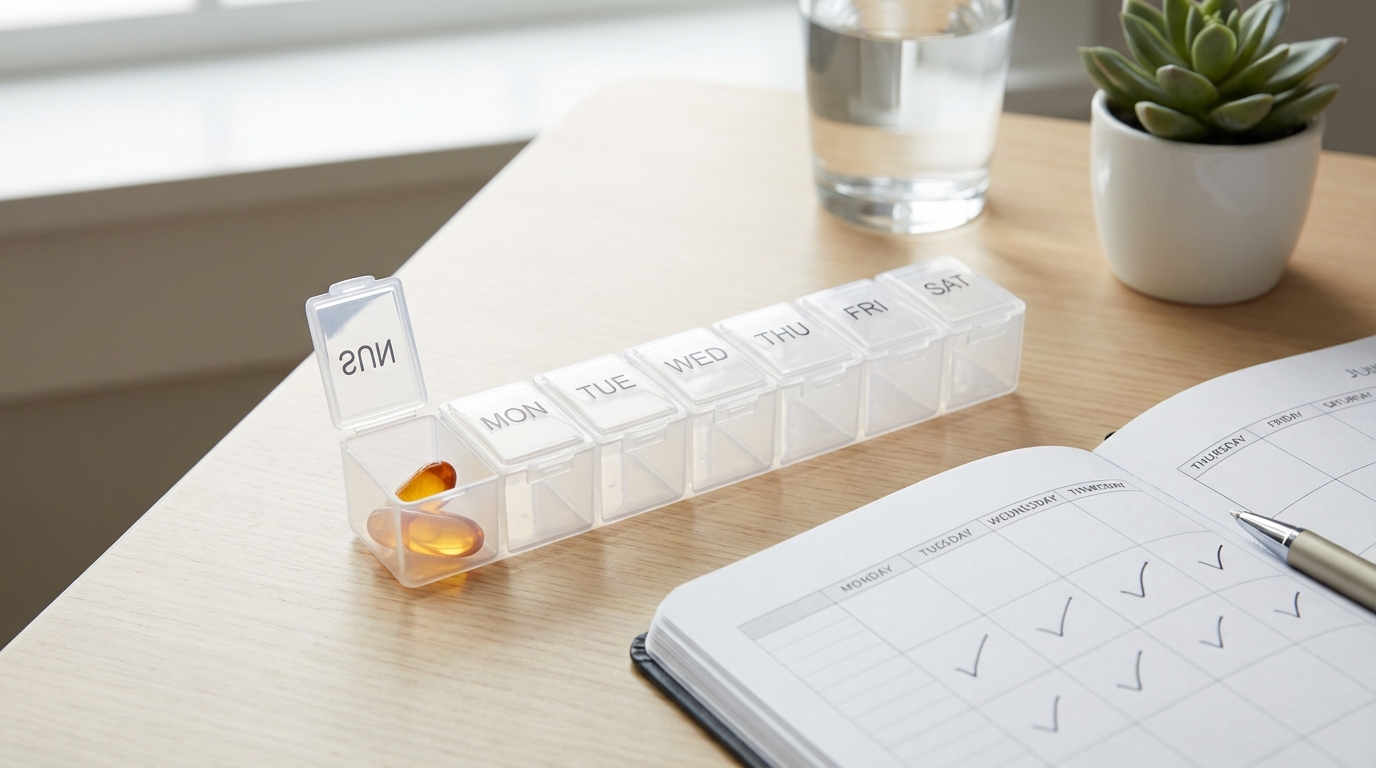
Research comparing the two protocols has found that both achieve similar outcomes in terms of raising 25(OH)D levels over 8-12 weeks. A study published in the Journal of Bone and Mineral Research found no significant difference in serum 25(OH)D at 12 weeks between weekly and equivalent daily dosing (Ish-Shalom et al., 2008). However, the weekly protocol consistently shows better adherence in clinical practice — patients are more likely to complete the full course when they only need to remember one pill per week.
Some clinicians have moved toward prescribing daily D3 at 5,000-7,000 IU as an alternative, especially for patients who experience GI discomfort from the weekly mega-dose. Discuss your preference with your doctor.
Who Needs 50,000 IU Vitamin D?#
Not everyone with low vitamin D needs this dose. Here is a practical breakdown:
50,000 IU weekly is appropriate for:
- Adults with serum 25(OH)D below 20 ng/mL (deficient)
- Patients with malabsorption conditions
- Individuals with BMI over 30 who have documented deficiency
- Patients on medications that deplete vitamin D
- Those with chronic kidney disease (under nephrology guidance)
50,000 IU weekly is NOT appropriate for:
- People with levels above 30 ng/mL seeking optimization
- Individuals without a confirmed blood test showing deficiency
- Anyone with hypercalcemia or a history of calcium kidney stones (without specialist clearance)
- Patients with granulomatous diseases (sarcoidosis, tuberculosis) — these conditions cause unregulated vitamin D activation and make toxicity far more likely
For general adult dosing recommendations, see our vitamin D dosage for adults guide.
Monitoring Requirements During 50,000 IU Therapy#
If you are taking vitamin D 50,000 IU weekly, regular blood work is essential. Here is what your doctor should monitor and when:
Baseline Testing (Before Starting)#
- 25(OH)D level — confirms deficiency and establishes starting point
- Serum calcium — rules out pre-existing hypercalcemia
- Serum phosphorus — assesses mineral balance
- Parathyroid hormone (PTH) — often elevated in deficiency (secondary hyperparathyroidism)
- Basic metabolic panel — evaluates kidney function (creatinine, BUN)
During Treatment (4-8 Weeks)#
- 25(OH)D level — to track response and adjust protocol
- Serum calcium — to detect early hypercalcemia
After Completing the Loading Phase (12 Weeks)#
- 25(OH)D level — to confirm target has been reached (goal: 30-50 ng/mL for most patients)
- Serum calcium — final safety check
- PTH — should normalize if deficiency has been corrected
Ongoing Maintenance#
After the loading phase, patients are typically transitioned to a maintenance dose of 1,000-2,000 IU daily (or 50,000 IU monthly). Blood levels should be rechecked every 3-6 months during the first year, then annually if levels remain stable.
If your provider is not ordering regular blood work while you are on high-dose vitamin D, ask for it. Monitoring is not optional at this dosage — it is a safety requirement.
50,000 IU of Vitamin D Equals How Many mcg?#
Understanding the conversion helps you compare your prescription to over-the-counter products and daily recommendations:
50,000 IU of vitamin D3 = 1,250 mcg (micrograms)
The conversion factor is straightforward: 1 IU of vitamin D3 = 0.025 mcg. So:
50,000 IU x 0.025 = 1,250 mcg
To put this in perspective:
- The RDA for most adults is 600 IU (15 mcg)
- The UL for adults is 4,000 IU (100 mcg)
- A common OTC supplement is 5,000 IU (125 mcg) — see the 5,000 IU to mcg conversion
- Your weekly prescription of 50,000 IU (1,250 mcg) contains the equivalent of about 83 days of RDA in a single capsule
For the exact conversion with our interactive tool, visit the 50,000 IU to mcg converter. Or use our IU to mcg converter for any dosage.
Convert Any Vitamin D Dosage#
Use our interactive calculator to convert between IU and mcg for any vitamin D3 amount:
Frequently Asked Questions#
Is 50,000 IU of vitamin D safe to take weekly?#
Yes, when prescribed by a physician for a documented deficiency and taken for a limited period (typically 8-12 weeks). The weekly dosing averages out to about 7,143 IU per day, which is above the UL of 4,000 IU but well within the range many endocrinologists consider safe for therapeutic use. Regular blood monitoring is essential. Long-term unsupervised use carries real risks, including hypercalcemia and kidney damage.
How long does it take for vitamin D 50,000 IU to work?#
Most patients notice symptomatic improvement (reduced fatigue, less bone and muscle pain) within 2-4 weeks. Blood levels of 25(OH)D typically reach the target range of 30-50 ng/mL within 8-12 weeks of weekly therapy. However, individual response varies based on starting levels, body weight, absorption capacity, and other factors.
Can I take vitamin D 50,000 IU daily instead of weekly?#
No — taking 50,000 IU daily would deliver 350,000 IU per week, which is extremely dangerous and would almost certainly cause vitamin D toxicity and severe hypercalcemia within days to weeks. The 50,000 IU dose is designed exclusively for weekly administration. If your doctor wants you on a daily high-dose protocol, it would typically be in the range of 5,000-10,000 IU per day, not 50,000 IU.
Should I take vitamin K2 with my 50,000 IU vitamin D prescription?#
Many integrative and functional medicine practitioners recommend pairing high-dose vitamin D with vitamin K2 (MK-7) to help direct the increased calcium absorption toward bones rather than soft tissues. While there is no formal guideline requiring K2 co-supplementation with prescription vitamin D, the scientific rationale is sound. A typical recommendation would be 100-200 mcg of K2 MK-7 daily. Learn more about this pairing in our vitamin D3 and K2 benefits guide. Always discuss with your prescribing physician before adding supplements.
What should I do if I miss a weekly dose?#
Take the missed dose as soon as you remember. If it is close to the time for your next scheduled dose (within 1-2 days), skip the missed dose and resume your regular weekly schedule. Do not take two 50,000 IU doses at once. Because vitamin D is fat-soluble and stored in the body, missing a single weekly dose is unlikely to significantly impact your overall treatment trajectory. However, try to maintain consistency for optimal results.
Sources:
- NIH Office of Dietary Supplements — Vitamin D Fact Sheet
- Mayo Clinic — Vitamin D
- Holick MF, et al. "Evaluation, Treatment, and Prevention of Vitamin D Deficiency: an Endocrine Society Clinical Practice Guideline." J Clin Endocrinol Metab. 2011;96(7):1911-1930.
- Martineau AR, et al. "Vitamin D supplementation to prevent acute respiratory tract infections." BMJ. 2017;356:i6583.
- Tripkovic L, et al. "Comparison of vitamin D2 and vitamin D3 supplementation." Am J Clin Nutr. 2012;95(6):1357-1364.
- Ekwaru JP, et al. "The importance of body weight for the dose response relationship of oral vitamin D supplementation." Nutrients. 2014;6(11):4472-4475.
- Ish-Shalom S, et al. "Comparison of daily, weekly, and monthly vitamin D3 in ethanol dosing protocols." J Bone Miner Res. 2008;23(7):1052-1060.