Why Vitamin D3 and K2 Work Better Together#
Understanding vitamin D3 and K2 benefits starts with one critical insight: these two vitamins are far more effective as a pair than either is alone. Vitamin D3 boosts your body's ability to absorb calcium from food, while vitamin K2 acts as a traffic director — guiding that calcium into your bones and teeth instead of letting it accumulate in your arteries and soft tissues. Research published in the International Journal of Endocrinology confirms that co-supplementation of D3 and K2 improves bone mineral density more effectively than D3 alone (van Ballegooijen et al., 2017).
If you are already taking vitamin D3 or considering it, adding K2 is one of the simplest upgrades you can make for long-term health.
What Is Vitamin D3?#
Vitamin D3, also known as cholecalciferol, is the form of vitamin D your skin produces when exposed to UVB sunlight. It is also the form found in animal-based foods like fatty fish, egg yolks, and liver. Unlike vitamin D2 (ergocalciferol), D3 is more bioavailable and raises blood levels of 25-hydroxyvitamin D more effectively (Tripkovic et al., 2012).
Your body converts D3 into its active hormonal form, calcitriol, which regulates over 1,000 genes involved in calcium metabolism, immune defense, and cell growth. Despite being called the "sunshine vitamin," an estimated 42% of American adults are deficient in vitamin D according to the NIH Office of Dietary Supplements.
What Is Vitamin K2?#
Vitamin K2 is a fat-soluble vitamin that belongs to the menaquinone family. The two most studied forms are:
- MK-4 — found in butter, egg yolks, and organ meats; shorter half-life, so it needs to be taken multiple times a day
- MK-7 — found in fermented foods like natto; longer half-life (stays active in the body for up to 72 hours), making it the preferred form for supplementation
Vitamin K2's primary job is activating two key proteins:
- Osteocalcin — binds calcium to bone matrix, strengthening your skeleton
- Matrix GLA Protein (MGP) — prevents calcium from depositing in arterial walls
Without adequate K2, these proteins remain inactive, and the calcium that D3 helps absorb can end up in the wrong places.
The Science: How D3 and K2 Complement Each Other#
Think of vitamin D3 as the calcium absorber and vitamin K2 as the calcium allocator. Here is how the synergy works step by step:
- D3 increases calcium absorption in the gut by up to 30-40%
- D3 activates osteocalcin production in bone-building cells (osteoblasts)
- K2 carboxylates (activates) osteocalcin, enabling it to bind calcium into bone
- K2 activates MGP, which blocks calcium from accumulating in blood vessels
When you take D3 without K2, your body absorbs more calcium but lacks the mechanism to direct it properly. Over time, this may contribute to arterial calcification — a concern highlighted in a 2019 review in the Journal of the American Heart Association (Mott et al., 2019). Adding K2 closes the loop, ensuring calcium goes where it is needed.
If you are unsure about your D3 dosage, check our Vitamin D3 Dosage Guide for detailed recommendations by age group and health status.
Key Benefits of Vitamin D3#
The benefits of vitamin D3 extend far beyond bone health. Here are the major areas supported by clinical evidence:
Bone Health and Calcium Metabolism#
Vitamin D3 is essential for calcium and phosphorus absorption. Without it, your body absorbs only 10-15% of dietary calcium. With adequate D3, that number rises to 30-40%. This is why deficiency directly correlates with osteoporosis and fracture risk, especially in older adults (NIH, 2024).
Immune System Support#
D3 modulates both innate and adaptive immunity. It helps your immune cells produce antimicrobial peptides (cathelicidins) that fight off infections. A meta-analysis in the BMJ found that vitamin D supplementation reduced the risk of acute respiratory infections by 12% overall, and by 70% in those with severe deficiency (Martineau et al., 2017).
Mood and Mental Health#
Low vitamin D levels are associated with higher rates of depression. The "winter blues" many people experience are partly linked to reduced D3 synthesis during shorter, darker days. Supplementation has shown modest but consistent mood improvements in clinical trials, particularly in those who are deficient.
Muscle Function and Strength#
D3 receptors are present in muscle tissue. Adequate levels support muscle protein synthesis, reduce the risk of falls in the elderly, and may improve athletic performance. A study in athletes found that those with serum 25(OH)D levels above 40 ng/mL had better muscle recovery and lower injury rates.
Vitamin D3 Benefits for Men#
Men have particular reasons to prioritize D3 intake:
- Testosterone support — A randomized controlled trial published in Hormone and Metabolic Research found that men who took 3,332 IU of vitamin D daily for one year had significantly higher testosterone levels compared to the placebo group (Pilz et al., 2011). Low vitamin D and low testosterone frequently co-occur.
- Muscle mass and strength — D3 supports lean muscle maintenance, which is critical for metabolic health and physical performance as men age.
- Cardiovascular health — Observational data links adequate vitamin D status with lower rates of hypertension and cardiovascular events in men. When paired with K2, the cardiovascular protection is amplified by preventing arterial stiffness.
- Prostate health — Emerging research suggests vitamin D may play a role in regulating prostate cell growth, though more clinical trials are needed.
Vitamin D3 Benefits for Skin#
Your skin is both a producer and a target of vitamin D3:
- Skin barrier function — D3 promotes the production of antimicrobial peptides and supports keratinocyte differentiation, strengthening the skin's protective barrier.
- Eczema and psoriasis — Multiple studies have found that people with eczema and psoriasis tend to have lower vitamin D levels. Supplementation may reduce symptom severity by modulating the immune response in the skin.
- Anti-aging properties — Vitamin D3 supports DNA repair mechanisms in skin cells exposed to UV damage. It also helps regulate inflammation, a key driver of premature skin aging.
- Wound healing — Adequate D3 levels are associated with faster wound healing due to its role in immune function and new tissue formation.
For topical use, vitamin D analogs are already FDA-approved for conditions like psoriasis (calcipotriene), underlining the vitamin's importance for skin health.
Where to buy#
Paid linkCompare combined vitamin D3 + K2 (MK-7) supplements on Amazonamazon.comBenefits of Taking D3 with K2#
When you combine vitamin D3 with K2, the benefits multiply. Here are the most impactful outcomes supported by research:
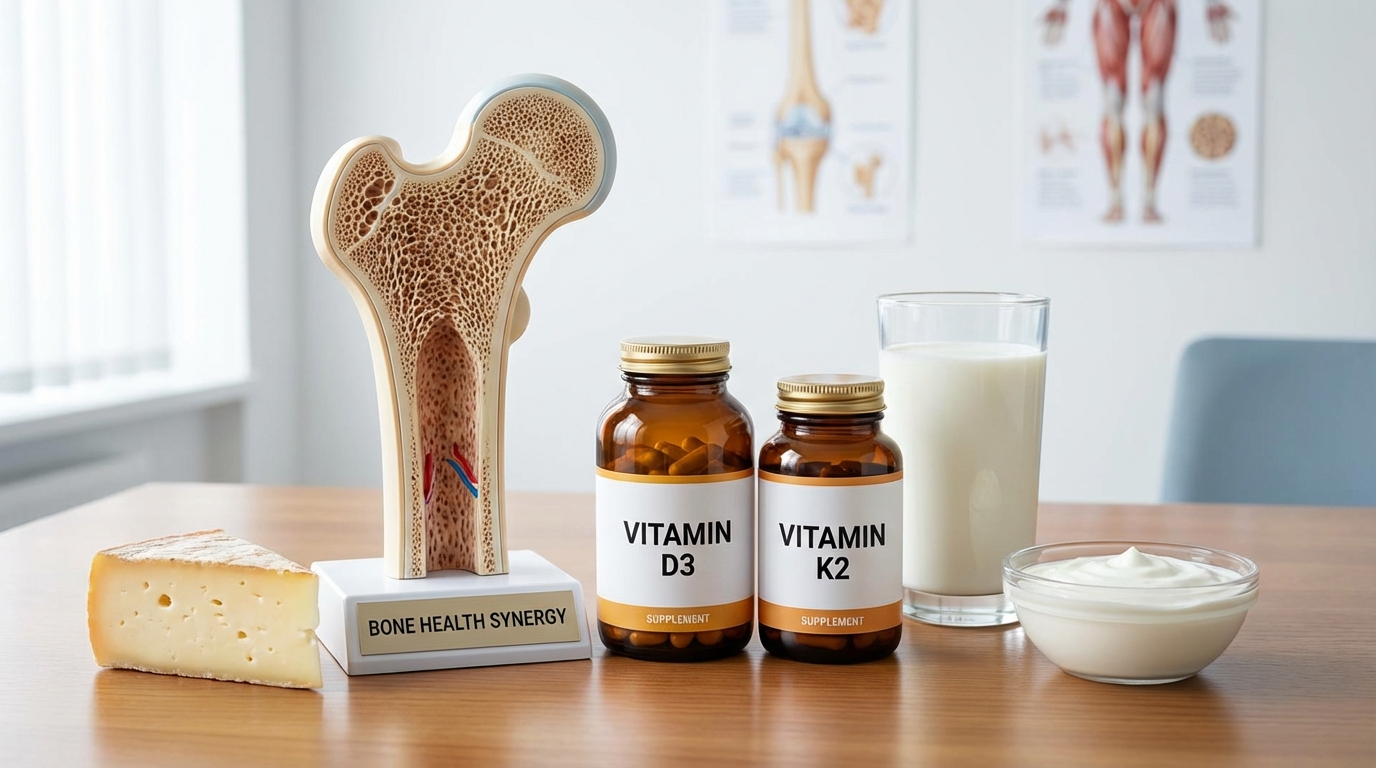
- Stronger bones — D3 enhances calcium absorption; K2 ensures it reaches bone tissue. Together, they reduce fracture risk more effectively than either alone.
- Healthier arteries — K2 activates MGP to clear calcium from blood vessel walls, countering the increased calcium load from D3 supplementation.
- Better cardiovascular outcomes — The Rotterdam Study, which followed 4,807 subjects, found that high dietary K2 intake was associated with a 57% reduction in death from heart disease (Geleijnse et al., 2004).
- Improved dental health — Osteocalcin activated by K2 also supports dentin remineralization, while D3 provides the calcium supply.
- Enhanced immune regulation — D3 activates immune cells; K2 helps modulate the inflammatory response, creating a balanced immune environment.
- Optimized calcium metabolism — The pair ensures calcium is absorbed, transported, and deposited efficiently — reducing the risk of kidney stones and soft tissue calcification.
- Support for metabolic health — Emerging evidence suggests the D3-K2 combination may improve insulin sensitivity, though this area needs further study.
- Reduced risk of vitamin D toxicity symptoms — K2 may mitigate some adverse effects of high-dose D3 by properly managing the calcium surplus.
Recommended Dosages#
General daily guidelines based on current evidence:
| Nutrient | Maintenance Dose | Higher Dose (Under Supervision) |
|---|---|---|
| Vitamin D3 | 1,000–2,000 IU (25–50 mcg) | 4,000–5,000 IU (100–125 mcg) |
| Vitamin K2 (MK-7) | 100 mcg | 200 mcg |
Key considerations:
- Always take D3 and K2 with a meal containing fat — both are fat-soluble vitamins.
- The optimal D3-to-K2 ratio is roughly 1,000 IU of D3 per 100 mcg of K2 MK-7, though individual needs vary.
- If you take blood thinners (warfarin/Coumadin), consult your doctor before taking K2, as it affects clotting factors.
- Need to convert your D3 dosage? Use our IU to mcg converter or check the quick conversion for 5,000 IU to mcg.
Vitamin D3 5000 IU: Benefits and Safety#
A daily dose of vitamin D3 5,000 IU (125 mcg) is commonly used by people with diagnosed deficiency, limited sun exposure, or higher body weight. The benefits of vitamin D3 5000 IU include:
- Faster correction of deficiency — Blood levels of 25(OH)D typically rise by 7-10 ng/mL per 1,000 IU of daily D3. At 5,000 IU, most people reach the optimal range of 40-60 ng/mL within 2-3 months.
- Enhanced immune function — Higher-dose supplementation has been studied in the context of respiratory infections and autoimmune conditions with positive results.
- Greater benefit for overweight individuals — Vitamin D is sequestered in fat tissue, so people with a higher BMI often need more to achieve adequate blood levels.
Safety notes:
- 5,000 IU per day is above the NIH tolerable upper limit of 4,000 IU for the general adult population, but many clinicians consider it safe for short-to-medium-term use under monitoring.
- The Endocrine Society suggests that up to 10,000 IU/day is unlikely to cause toxicity in most adults, though routine use above 4,000 IU should involve periodic blood testing.
- When taking 5,000 IU of D3, pairing it with at least 100-200 mcg of K2 (MK-7) is especially important to manage the increased calcium absorption.
- Signs of vitamin D toxicity include nausea, excessive thirst, frequent urination, and confusion — if you experience these, stop supplementation and consult a healthcare provider.
Calculate Your D3 Dosage#
Not sure how much vitamin D3 you need? Use our interactive calculator to convert between IU and mcg and find the right dosage for your needs:
Bottom Line#
The combination of vitamin D3 and K2 is one of the most well-supported supplement pairings in nutritional science. Vitamin D3 unlocks your body's ability to absorb calcium and supports everything from bone density to immune defense, mood, and skin health. Vitamin K2 ensures that calcium goes where it belongs — into your bones and teeth — and stays out of your arteries.
Whether you are a man looking to support testosterone and cardiovascular health, someone managing a skin condition, or simply trying to correct a deficiency with 5,000 IU daily, adding K2 to your D3 regimen is essential. Aim for 1,000-2,000 IU of D3 with 100 mcg of K2 MK-7 for maintenance, or up to 5,000 IU of D3 with 200 mcg of K2 under professional guidance.
Always test your 25(OH)D blood levels to know where you stand, and consult a healthcare provider before starting high-dose supplementation.
Related Guides#
- Vitamin D3 Dosage for Seniors Over 70 — K2 is especially critical for older adults, who face higher risks of both osteoporosis and arterial calcification.
- Vitamin D and Magnesium — another important nutrient pairing, since magnesium is required for your body to convert vitamin D into its active form.
Sources:
- NIH Office of Dietary Supplements — Vitamin D Fact Sheet
- van Ballegooijen AJ, et al. "The Synergistic Interplay between Vitamins D and K for Bone and Cardiovascular Health." Int J Endocrinol. 2017.
- Martineau AR, et al. "Vitamin D supplementation to prevent acute respiratory tract infections." BMJ. 2017;356:i6583.
- Pilz S, et al. "Effect of vitamin D supplementation on testosterone levels in men." Horm Metab Res. 2011;43(3):223-225.
- Geleijnse JM, et al. "Dietary intake of menaquinone is associated with a reduced risk of coronary heart disease: the Rotterdam Study." J Nutr. 2004;134(11):3100-3105.
- Tripkovic L, et al. "Comparison of vitamin D2 and vitamin D3 supplementation." Am J Clin Nutr. 2012;95(6):1357-1364.